
Petrikivka
UA

Tradition · sourced

A painting that lives on a wall and gets replaced every year

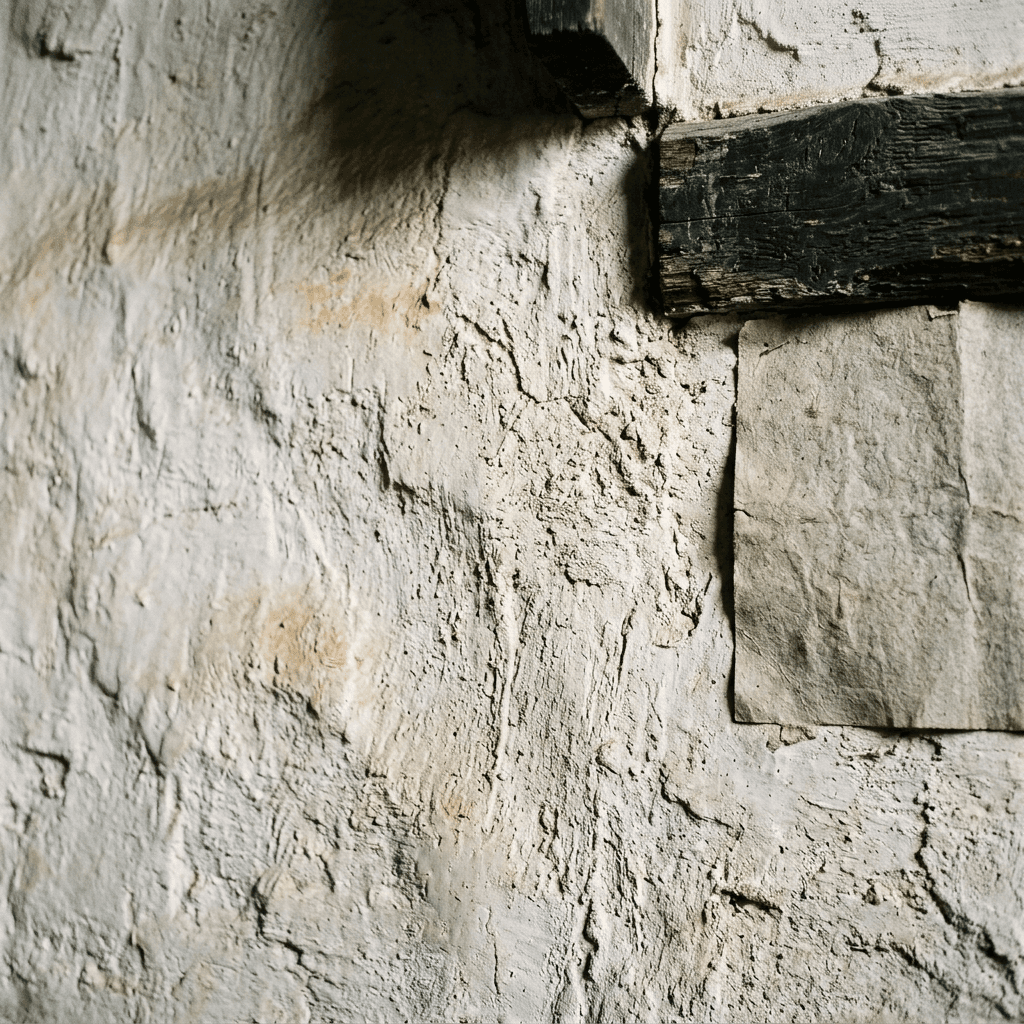
Thick white limewash over the stonework of an old house wall, meeting a weathered dark beam at the corner
Limewash over stone · interpretation, photographed for this site

Petrykivka began as decoration on the whitewashed walls of houses in one settlement on the Dnipro. It was painted by women, on surfaces that were washed over and painted again, which is why so little of the early work survives and why the living practice matters more than any single object.

What it is made of

Cat fur, a reed, and a finger

The fine work is done with a brush the painter makes herself, traditionally from soft cat fur bound to a stick — the koshachka (the cat-fur brush). The thinnest lines of all come off its tip: petushynnia (the feather-fine tracery). A sharpened stem of marsh reed draws the hairline work, and the berries are set with a fingertip.

Hands at a dark workbench binding a tuft of pale soft hair to a wooden stick with waxed thread, scissors and a spool beside them
Binding a koshachka · interpretation, photographed for this site
A reed stem cut to a fine dark point, lying on a torn-edged sheet of handmade paper
A sharpened reed · interpretation, photographed for this site
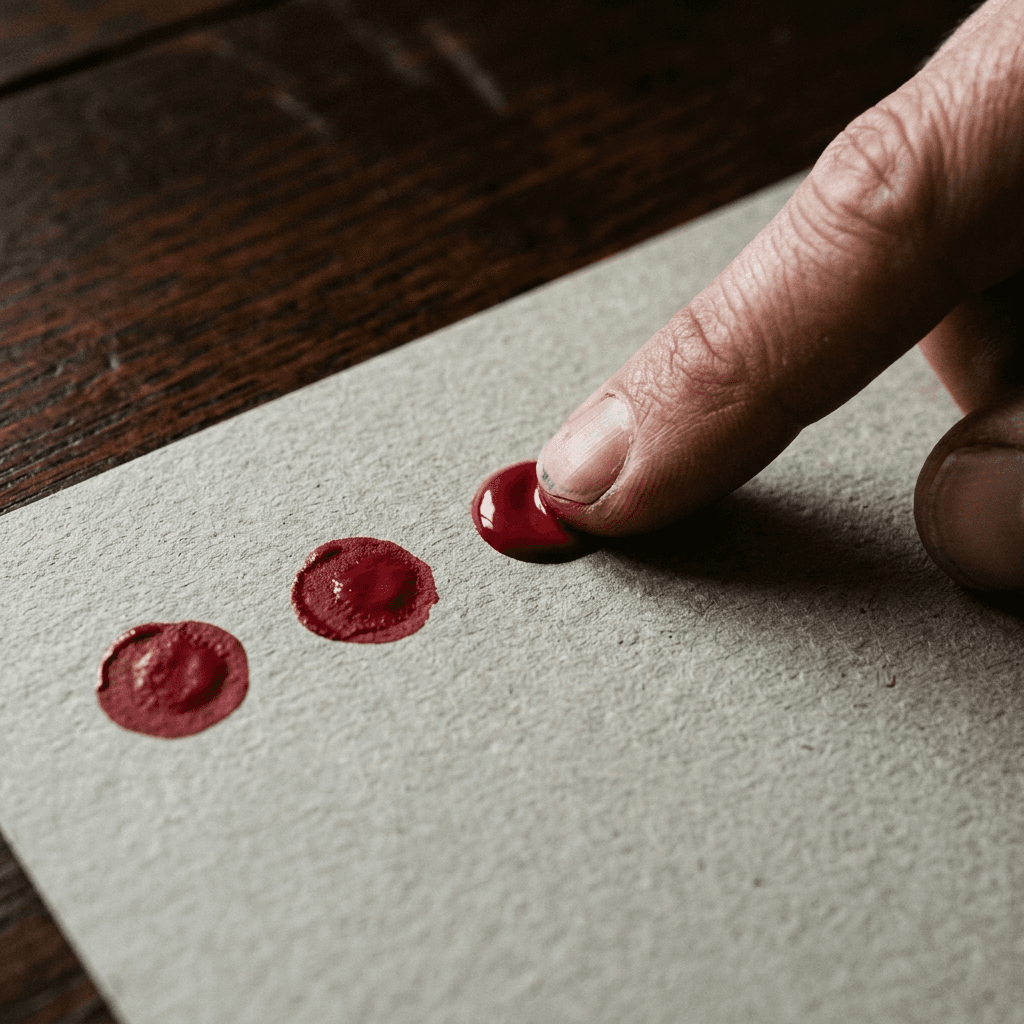
A fingertip pressing a dark red berry onto a grey-white sheet, two berries already set in a row beside it
A berry set with the pad of a finger · interpretation, photographed for this site

Where the colour came from

Cherry juice, onion skin, then aniline

Colour came from the fields before it came from a shop: cherry juice for red, couch grass and nightshade leaves for green, blue squill for blue, sunflower petals, onion skin and apple-shoot bark for the yellows, with chalk, local clays and soot for wall work. It was bound in egg yolk and milk and fixed with cherry gum or beet sugar. Cheap aniline dyes arrived at the end of the nineteenth century, and the range specialists call traditional — pink, green, yellow and a little blue on white paper — is that early aniline one. Gouache and watercolour became normal only after the Second World War.

A sunflower field in full flower running to the horizon under a blue summer sky
Sunflower petals gave the yellows · interpretation, photographed for this site
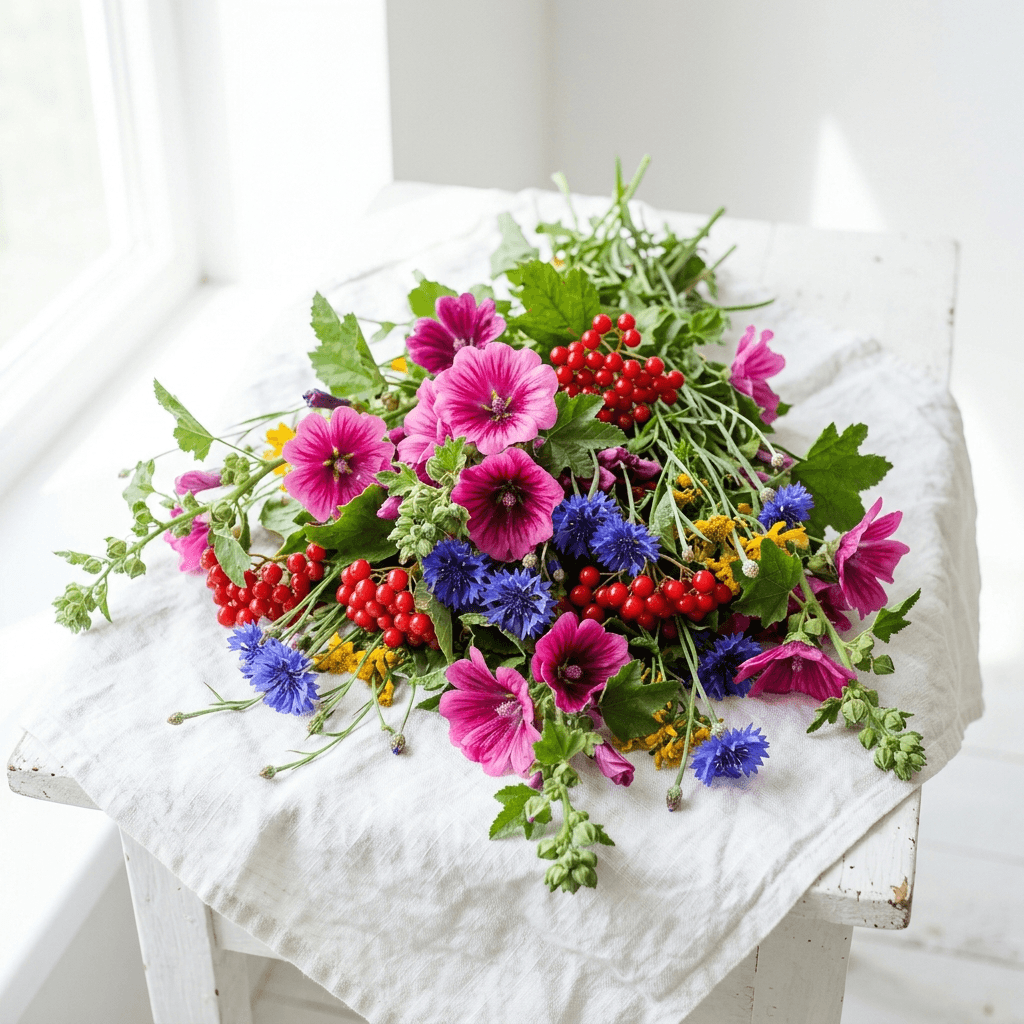
A bunch of pink mallow, blue cornflowers and red viburnum berries on white cloth by a window
Mallow, cornflower and viburnum — the same plants the paint came from and the same ones the ornament names · interpretation, photographed for this site
Shallow ceramic saucers of thick carmine, ochre, green and cobalt paint beside a jar of clouded water
Four paints ground and ready · interpretation, photographed for this site
An egg yolk in a half shell on a white saucer beside a heap of ochre powder and a stone muller
Yolk and ground earth, the old binder · interpretation, photographed for this site
A brush swirling pink, green and yellow paint together into a spiral on a white china plate
Mixing on a plate · interpretation, photographed for this site

The ground

A white wall and a white sheet

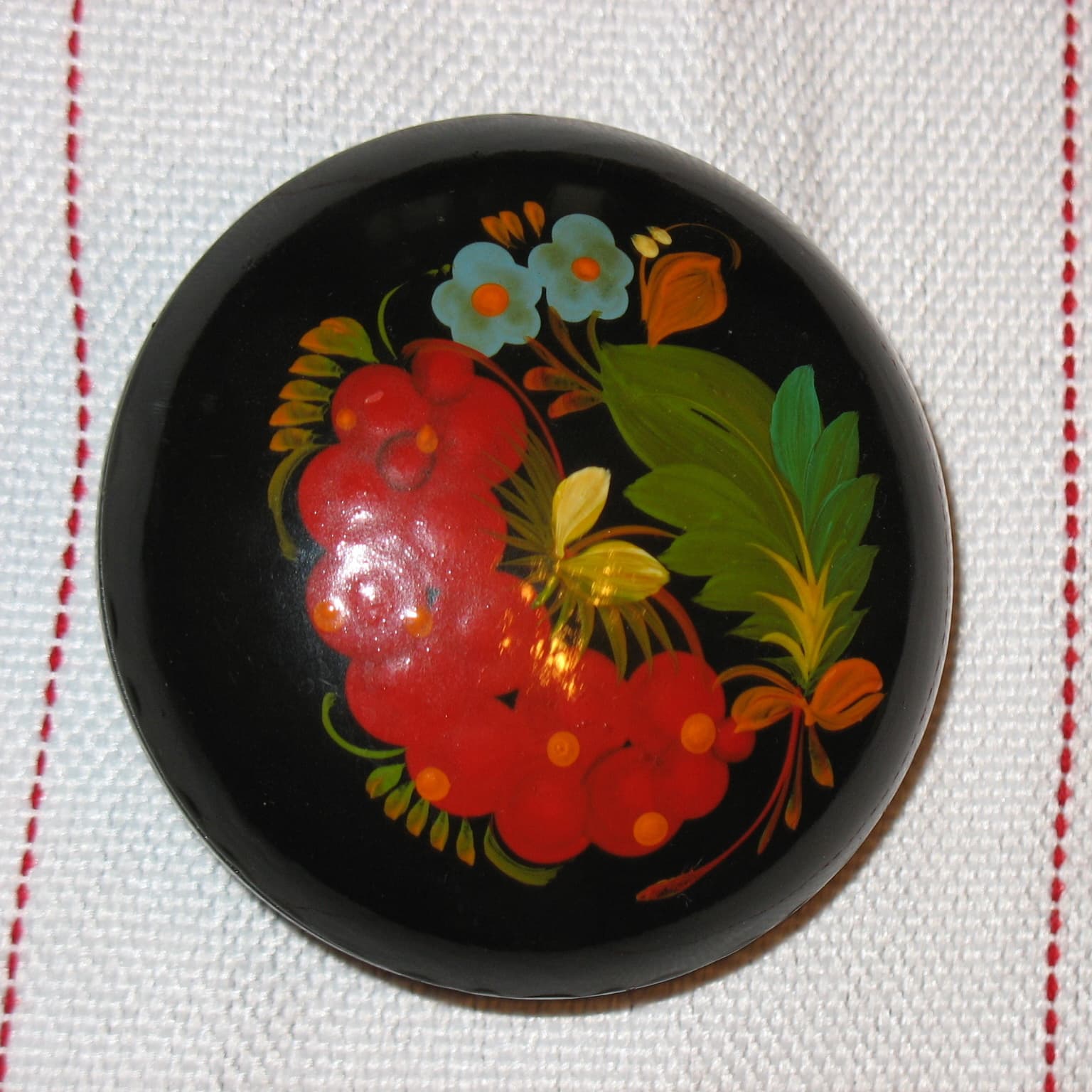
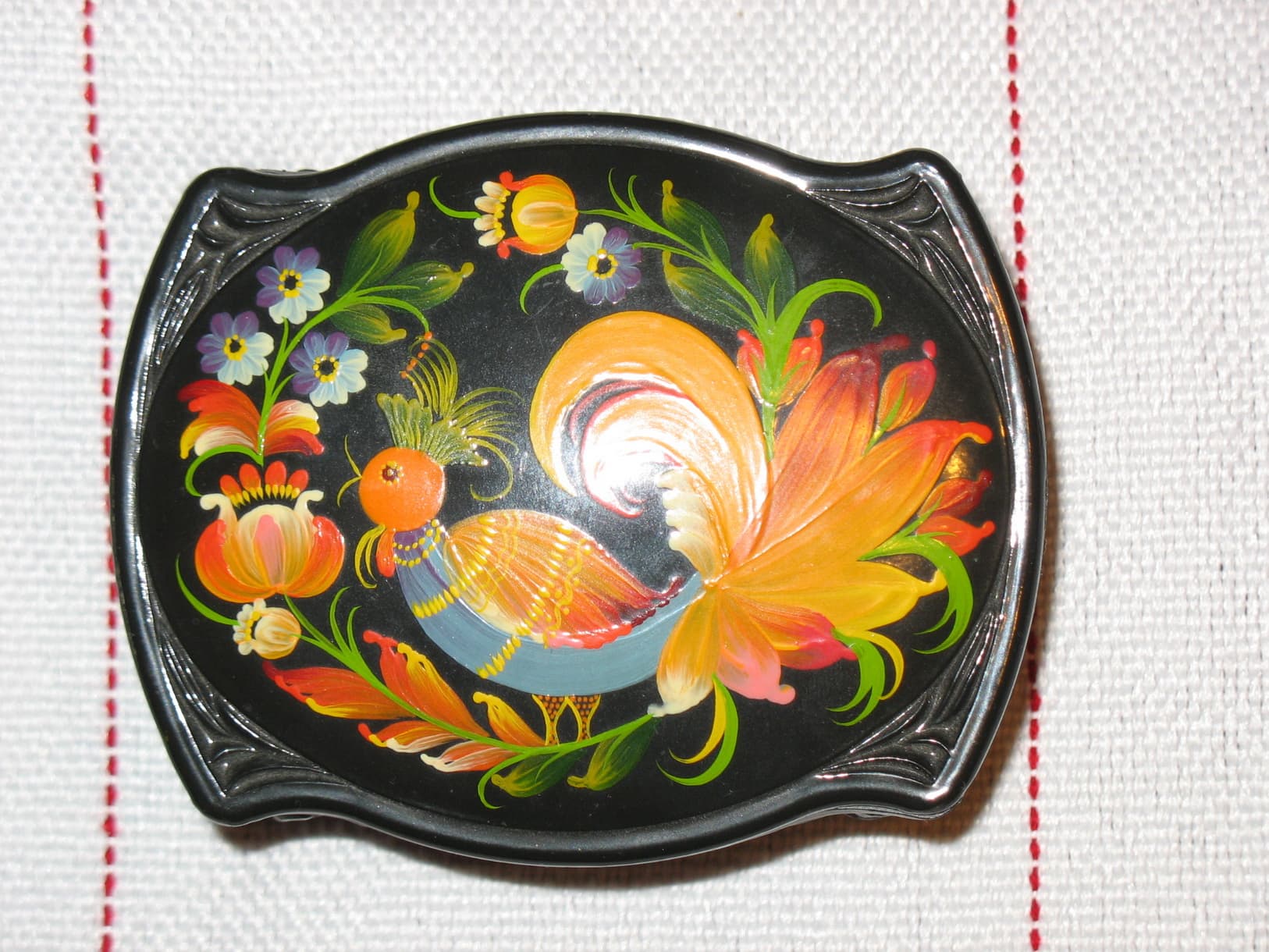
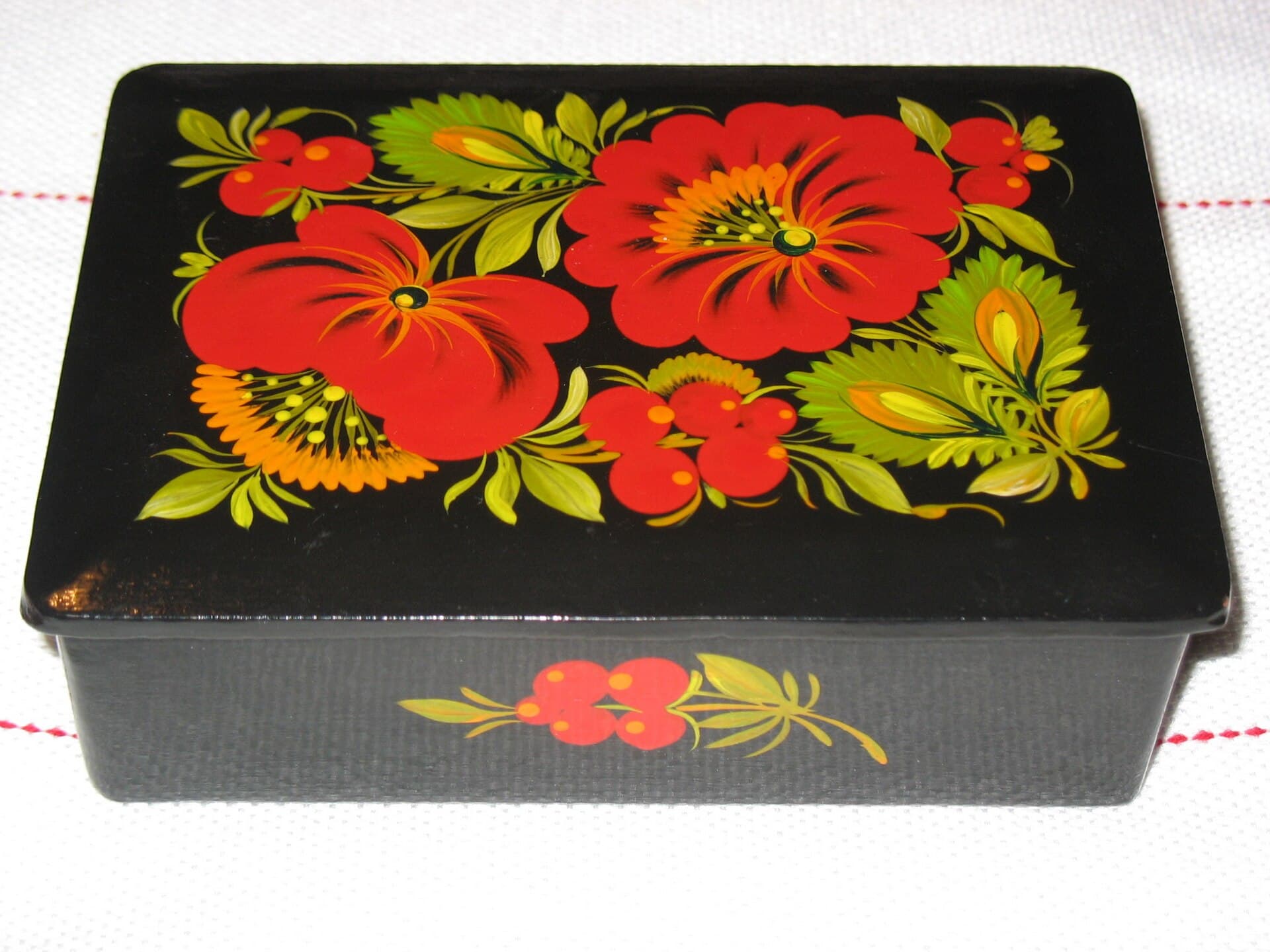
The black lacquered objects most people picture came from somewhere else. Painting under lacquer on a black ground was introduced at the Shevchenko souvenir factory in Kyiv, where Petrykivka women who had moved to the city worked, and it returned to the village afterwards; the Druzhba factory then made it the public image of the craft. The historic ground here is white — a limewashed wall or white paper — and Panko’s experimental workshop deliberately worked back toward light grounds after 1970.

The inside corner of a clay cottage under thick uneven limewash, with a small niche shelf and a dark ceiling beam
The wall as it was painted on · interpretation, photographed for this site
A tall stack of white deckle-edged handmade sheets on a small table in front of a bright garden window
The second white ground: a stack of paper for malovky (painted paper sheets) · interpretation, photographed for this site
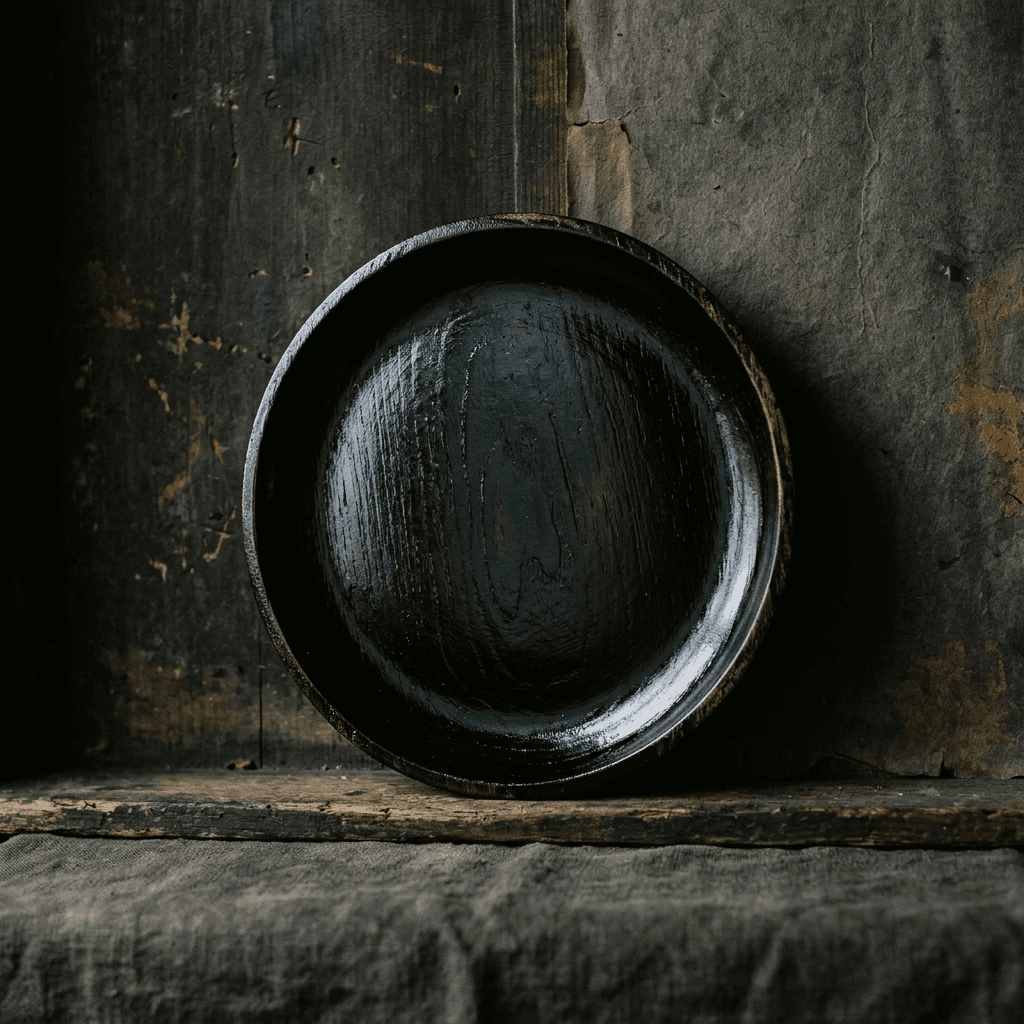
A black lacquered wooden plate standing on edge against a dark wall, its surface still bare
The lacquered blank, a factory form that arrived in the 1940s · interpretation, photographed for this site

Nothing drawn underneath

Laid straight onto the surface

The painting is laid straight onto the surface with nothing drawn underneath. That single fact explains the whole vocabulary of named strokes: a painter is building from marks she can place without correction.

A woman at a window table pulling a single bright pink petal onto a blank white sheet with a thin brush
One petal, first mark on the sheet · interpretation, photographed for this site

Timeline

From a Cossack settlement to a UNESCO listing

Ten dated points, each with the source it comes from.

1772

A Cossack settlement on the Chaplynka

Petrykivka is founded in the lands of the Zaporozhian Host. It grew into a large free settlement, passing eleven thousand people by the 1880s, with three churches, a synagogue and twenty-nine shops. The painting itself is younger than the village, and no scholarly source places it before the nineteenth century.

Petrykivka village encyclopedia ↗
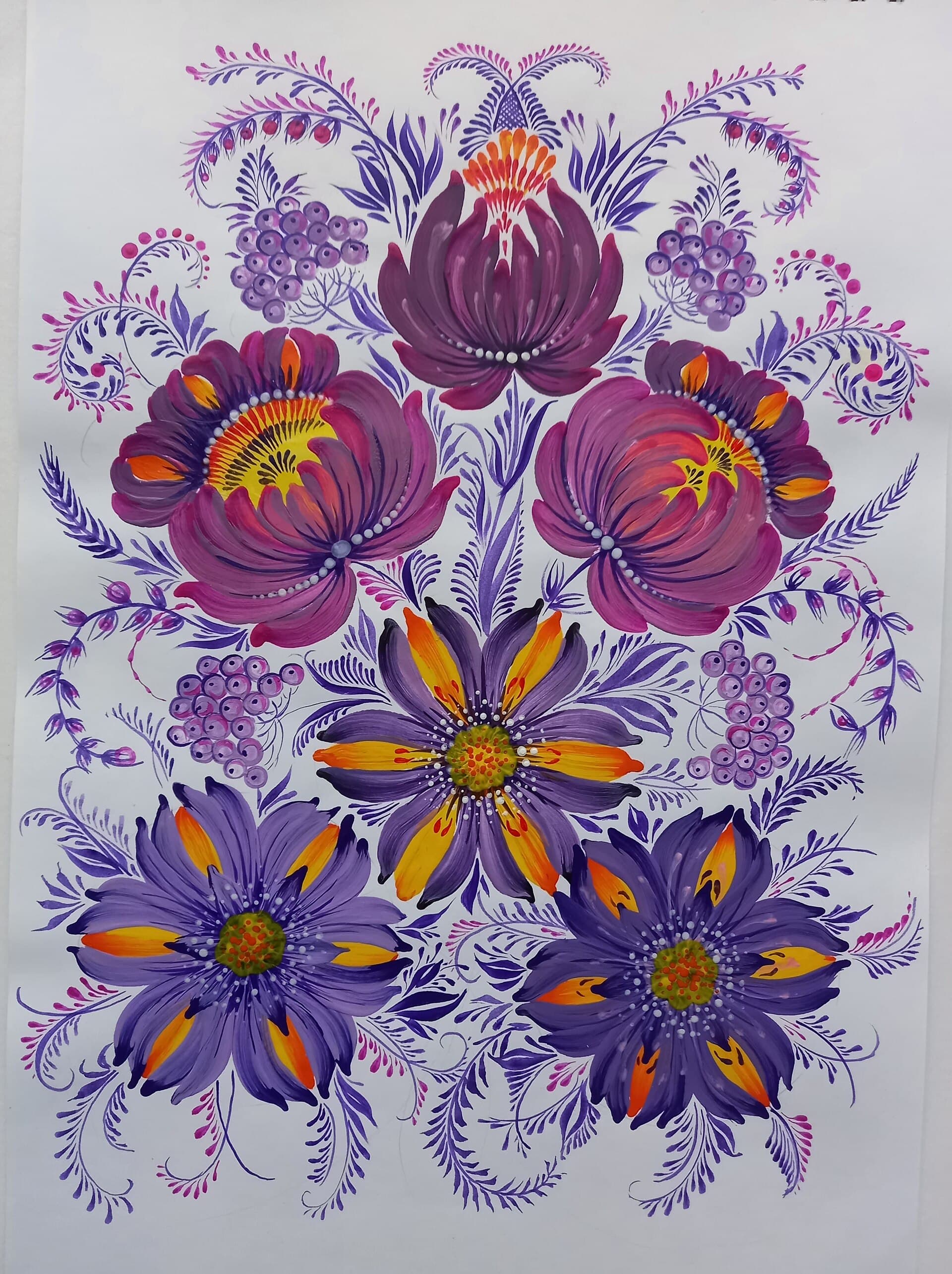
19th c.

Painting on the walls of the house

The painting lived on whitewashed cottage walls, on the stove and the chimney, and on sheets of paper — the malovka — pasted up and replaced through the year. Women painted, and a woman known for it was a chepurushka (the one who dresses the house up). None of those nineteenth-century wall paintings survive; what museums hold are painted sheets from the 1910s and 1920s.

Scholarly article, PDF ↗
1890s

Aniline dyes arrive, and paper takes over

Cheap bright aniline colours reach the village at the end of the nineteenth century. They displace the plant and clay pigments and they make the painted paper sheet practical. Specialists call that early aniline range — pink, green, yellow, a little blue on white paper — the traditional palette. The plant colours belong to the stratum beneath it.

Great Ukrainian Encyclopedia ↗
1936

The village school of decorative painting

A school of decorative painting opens in Petrykivka, founded by Oleksandr Statyva, with Tetiana Pata teaching. The generation she trained — Fedir Panko, Vasyl Sokolenko and others — carried the tradition through the rest of the century. Pata received the title Honoured Master of Folk Art of the Ukrainian SSR in 1962.

Encyclopedia of Modern Ukraine ↗
1940s

Black lacquer, which came from somewhere else

Under-lacquer painting on a black ground is introduced at the Shevchenko souvenir factory in Kyiv, where Petrykivka women who had moved to the city worked, and it comes back to the village later. The black ground most people now picture was never traditional here. The historic ground is white: a limewashed wall or white paper.

KNUKiM library, «Treasures of the nation» ↗
1958

A children's art school in the village

The Petrykivka children's art school opens as a branch of Dnipropetrovsk Children's Art School No. 1, with O. Z. Latun as its first head and Fedir Panko and Vasyl Sokolenko among its first teachers. It later took Tetiana Pata's name.

Museum exhibition page ↗
1991

The masters become co-owners

Andrii Pikush organises the creative association «Petrykivka», with the folk masters holding it as co-owners. The Centre's own account dates it to 23 October 1991.

KNUKiM library, «Treasures of the nation» ↗
1995

The school stands on its own

The children's art school becomes an independent institution, headed by Maria Pikush.

Museum exhibition page ↗
1998

The Centre of Folk Art «Petrykivka»

The Experimental Workshop's collective and premises merge with the association to form the Centre of Folk Art «Petrykivka». Its organiser and long-serving head is Andrii Pikush.

Wikipedia article on the Centre ↗
2012

Ukraine puts it on its own list first

On 14 December the Ministry of Culture, by Order No. 1521, enters Petrykivka painting into Ukraine's National List of Intangible Cultural Heritage as element 004n.k.s. (the register's own code, transliterated).

Ministry of Culture register, PDF ↗
2013

Brussels, then Baku

On 29 January an exhibition of Petrykivka painting opens at the European Parliament in Brussels — more than ninety works by folk masters of the Dnipropetrovsk region, presented by an oblast delegation as part of the UNESCO campaign. That December, at its eighth session in Baku, the Committee adopts Decision 8.COM 8.29 and inscribes Petrykivka painting as file 00893: Ukraine's first element on the Representative List.

UNESCO decision 8.COM 8.29 ↗
2020

The name itself gets protection

On 26 October the geographical indication No. 3121, «Petrykivka painting» (Petrykivskyi rozpys), is registered — one of only two Ukrainian folk-craft geographical indications.

Ukrpatent registration No. 3121, PDF ↗
2022

The collection goes to a secret place, the painters stay

Ahead of the full-scale invasion the museum's historic collection is moved somewhere safe. Reporting from the village that July found the masters still working; one of them had stopped for three months and gone back to the brush because it steadied her.

Radio Free Europe report from the village ↗
2025

In defence of identity

On 9 March the National Taras Shevchenko Prize goes to A. Karpets-Yermolaieva, Andrii Pikush, Maria Pikush and N. Rybak for the project «Petrykivka painting: in defence of identity» — the title the masters gave it themselves. The same year the UK Heritage Crafts Red List classifies Petrykivka decorative painting as Endangered.

LB.ua report on the prize ↗

What all of that produces

Six works, painted by hand

Paper, porcelain and wood, each kept with the credit and licence of the file it came from.

Rose vazon on white

Rose vazon on white

The vertical vazon in its plainest form, on the historic white ground.

Sunshine ND · CC BY-SA 4.0 · painter unrecorded

Carpet of poppies and asters

Carpet of poppies and asters

The kylymok — a field composition that fills its rectangle evenly from edge to edge.

Sunshine ND · CC BY-SA 4.0 · painter unrecorded

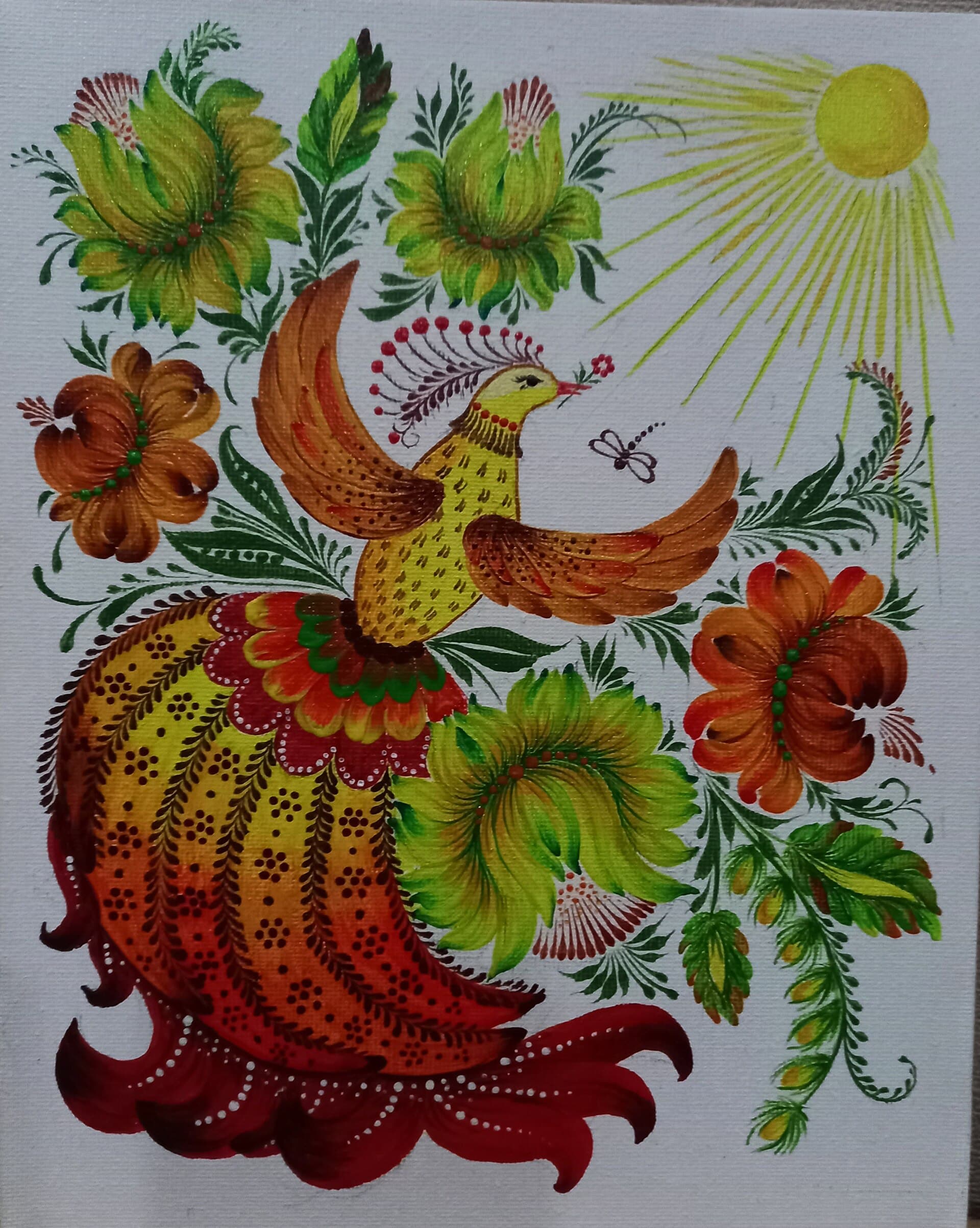
Firebird over a red bloom

Firebird over a red bloom

The bird motif at full stretch, with the sun in the corner and petushynnia carrying the tail.

Sunshine ND · CC BY-SA 4.0 · painter unrecorded

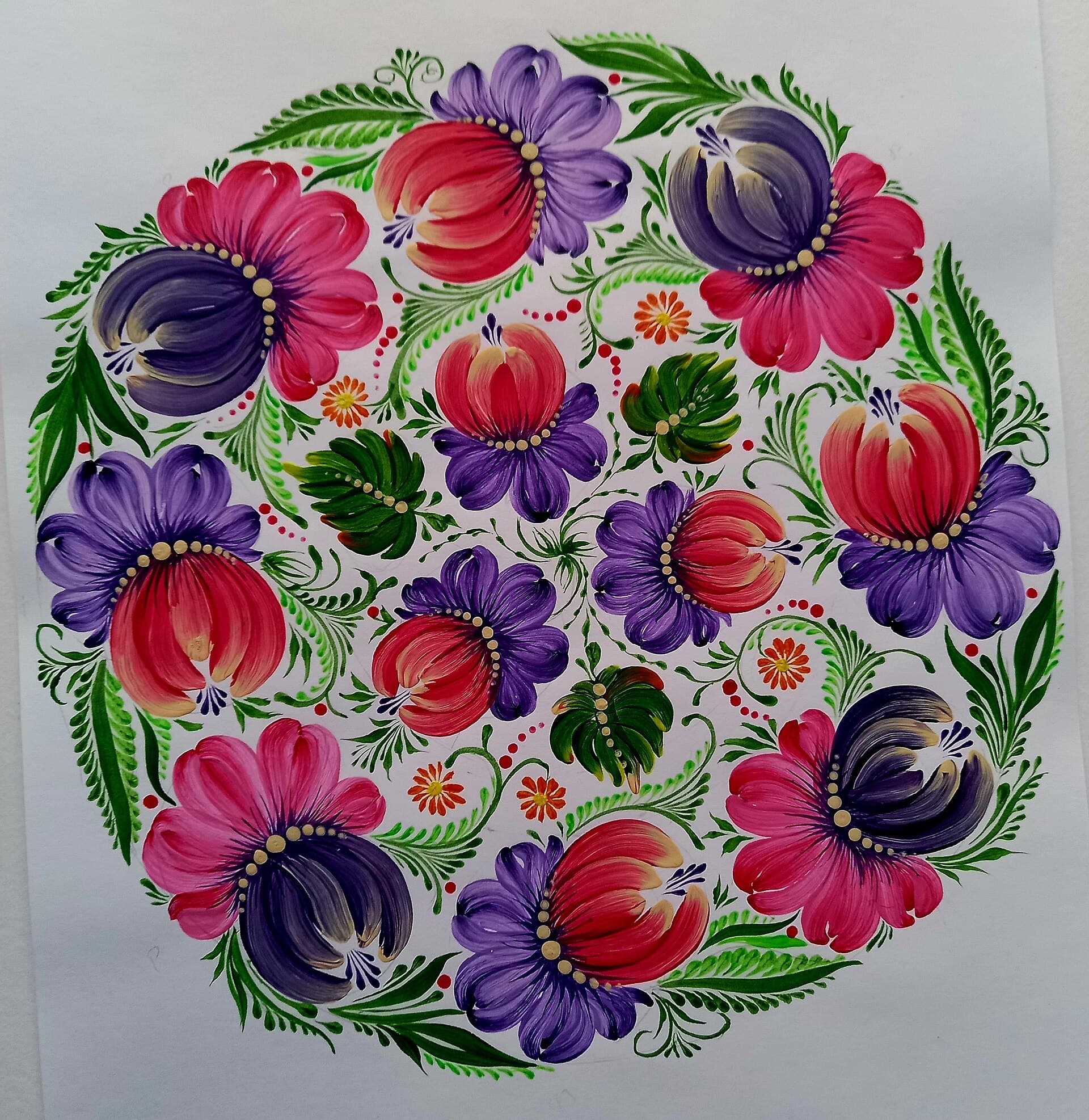
Wreath of tulips and dark blooms

Wreath of tulips and dark blooms

A closed round composition built from alternating tilts, which is what keeps a wreath from going mechanical.

Sunshine ND · CC BY-SA 4.0 · painter unrecorded

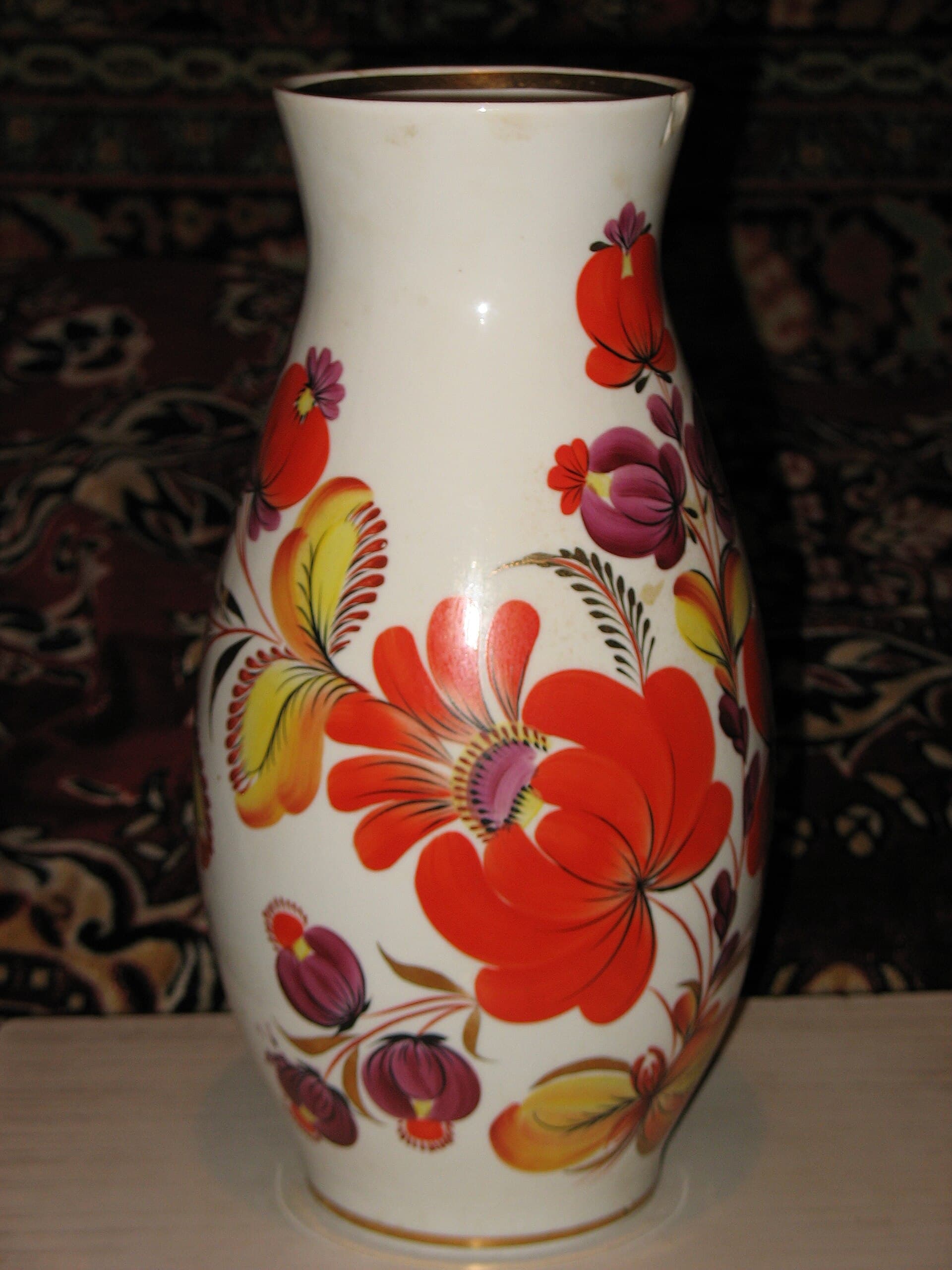
Porcelain vase

Porcelain vase

Painted by Marfa Tymchenko

Overglaze painting on porcelain, made at the Kyiv experimental ceramic-art factory in the second half of the twentieth century.

AnnaTroicka · CC BY-SA 3.0

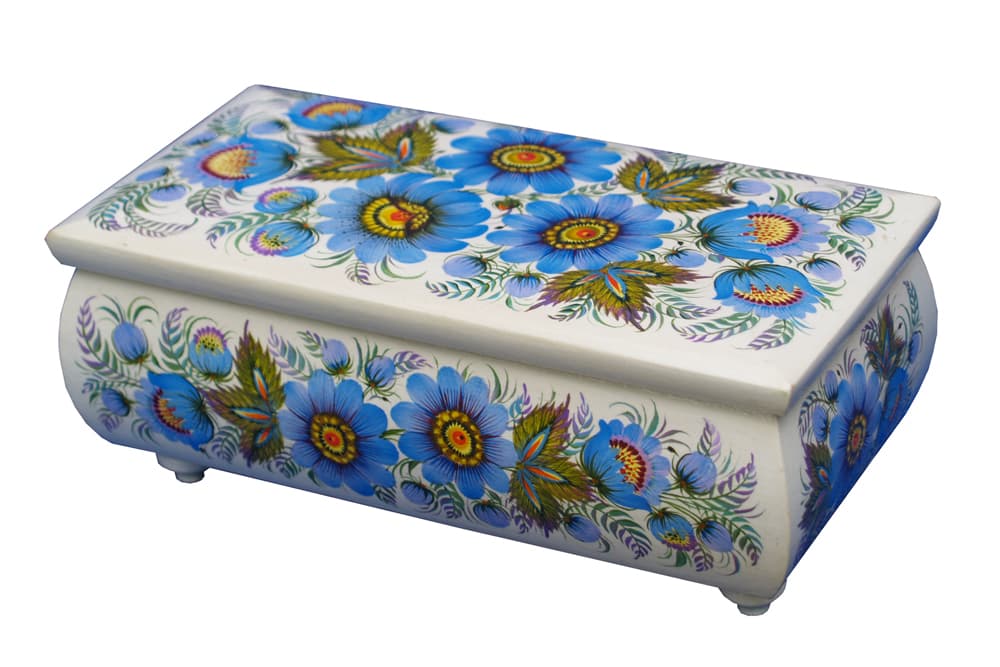
Chest, «Blue flowers»

Chest, «Blue flowers»

Painted by Nataliia Statyva-Zharko

A painted wooden chest in a cool blue range, away from the red-and-gold the factory made familiar.

Nataliia Statyva-Zharko · CC BY-SA 4.0

Every work →

UNESCO, 2013

What was actually inscribed

The element on the Representative List is Petrykivka decorative painting as a phenomenon of the Ukrainian ornamental folk art, file 00893, inscribed in December 2013 at the Committee’s eighth session in Baku by Decision 8.COM 8.29. It was Ukraine’s first element on that list. UNESCO’s own description notes that the people of the village decorate their living quarters, household belongings and musical instruments in this style, and that every family has at least one practitioner.

An inscription protects a practice by obliging the state to keep it transmissible. It puts no floor under a painter’s income. The name itself did get a legal guard in 2020, when the geographical indication No. 3121, «Petrykivka painting» (Petrykivskyi rozpys), was registered — one of only two Ukrainian folk-craft geographical indications. In 2025 the UK Heritage Crafts Red List classified the painting as Endangered.

Read the UNESCO entry

Recognition on paper and metal

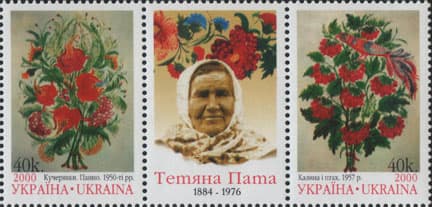
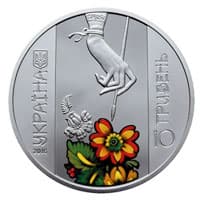
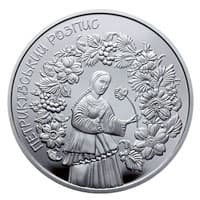
The state put the painting on a stamp and a coin

Three official issues, photographed from the objects themselves.

Postage stamps in honour of Tetiana Pata

Postage stamps in honour of Tetiana Pata

Ukrposhta, 2000. A se-tenant honouring the teacher the school came from.

Ukrposhta · Public domain

Commemorative coin, obverse

Commemorative coin, obverse

National Bank of Ukraine, «Petrykivka painting», 2016.

National Bank of Ukraine · Public domain

Commemorative coin, reverse

Commemorative coin, reverse

National Bank of Ukraine, «Petrykivka painting», 2016.

National Bank of Ukraine · Public domain

Telling it apart

How to recognise the real thing

A painted bihunets (the running border) changes the tilt of every flower along the band; a repeated vector one does not. A perekhidnyi mazok (the transitional stroke) carries its colour change inside a single mark, with no seam where two colours meet. Berries set with a finger have a fingerprint edge. Petushynnia thins away to nothing at the tip, which a printed line rarely does.

Any work shown on this site will name the person who painted it. Anything generated or printed will say so on its own page.

A thread-bound handmade brush lying on a dark table with crimson and ochre paint sitting side by side on the one tip
Two paints on one tip, before the stroke · interpretation, photographed for this site
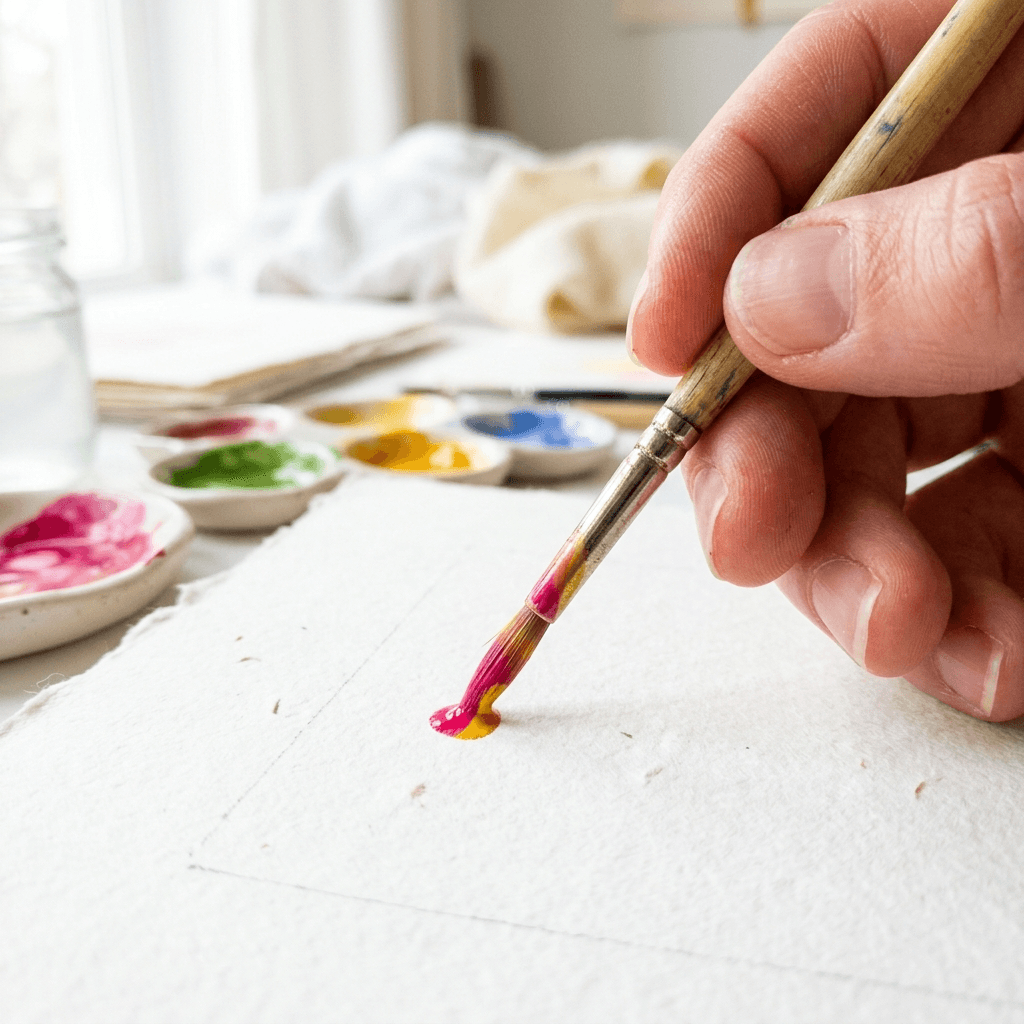
A hand drawing a thin pink line across a white sheet with a fine brush held almost upright
A line thinning away at the tip · interpretation, photographed for this site
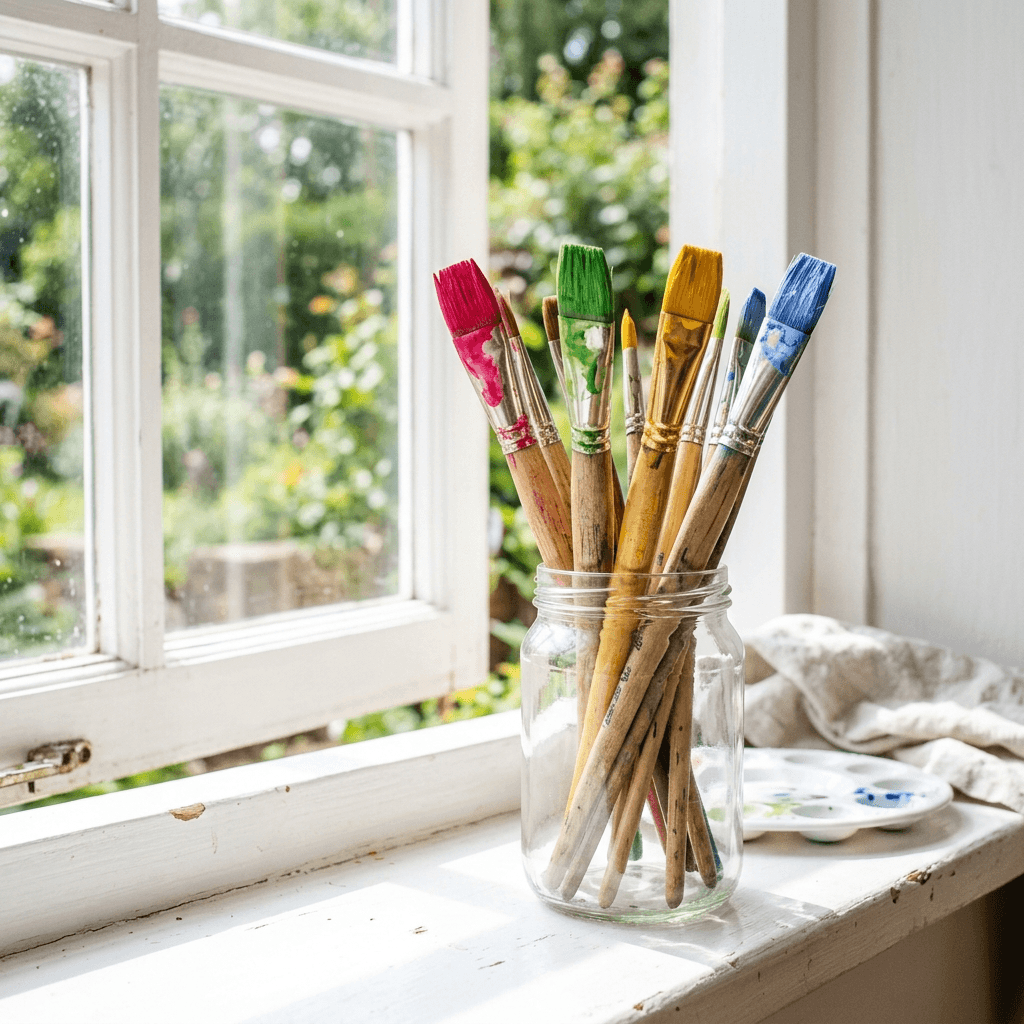
Handmade brushes with pink, yellow, green and blue on their tips standing in a glass jar on a sunlit windowsill
A jar of brushes between sessions · interpretation, photographed for this site

Where it ends up

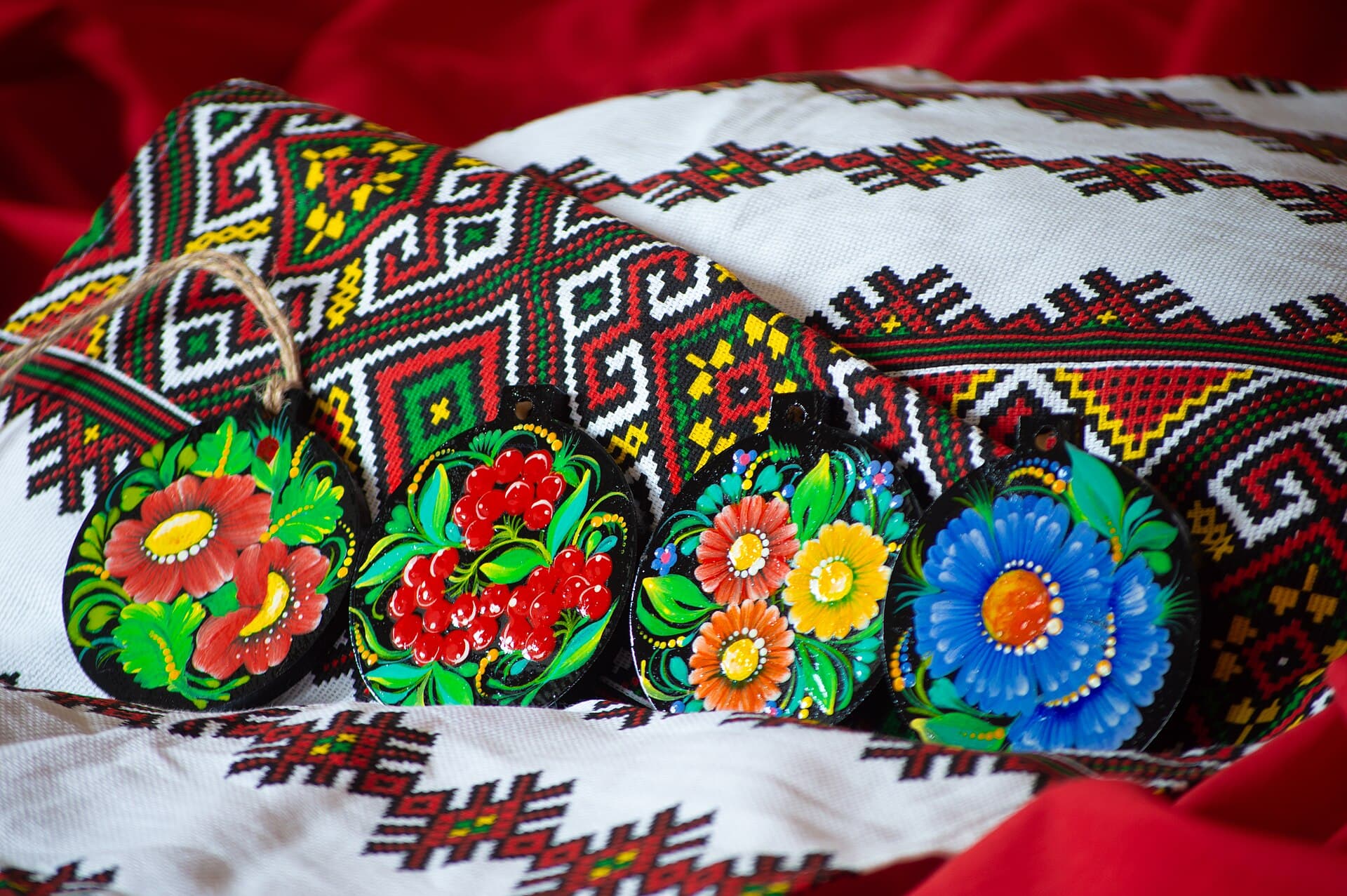
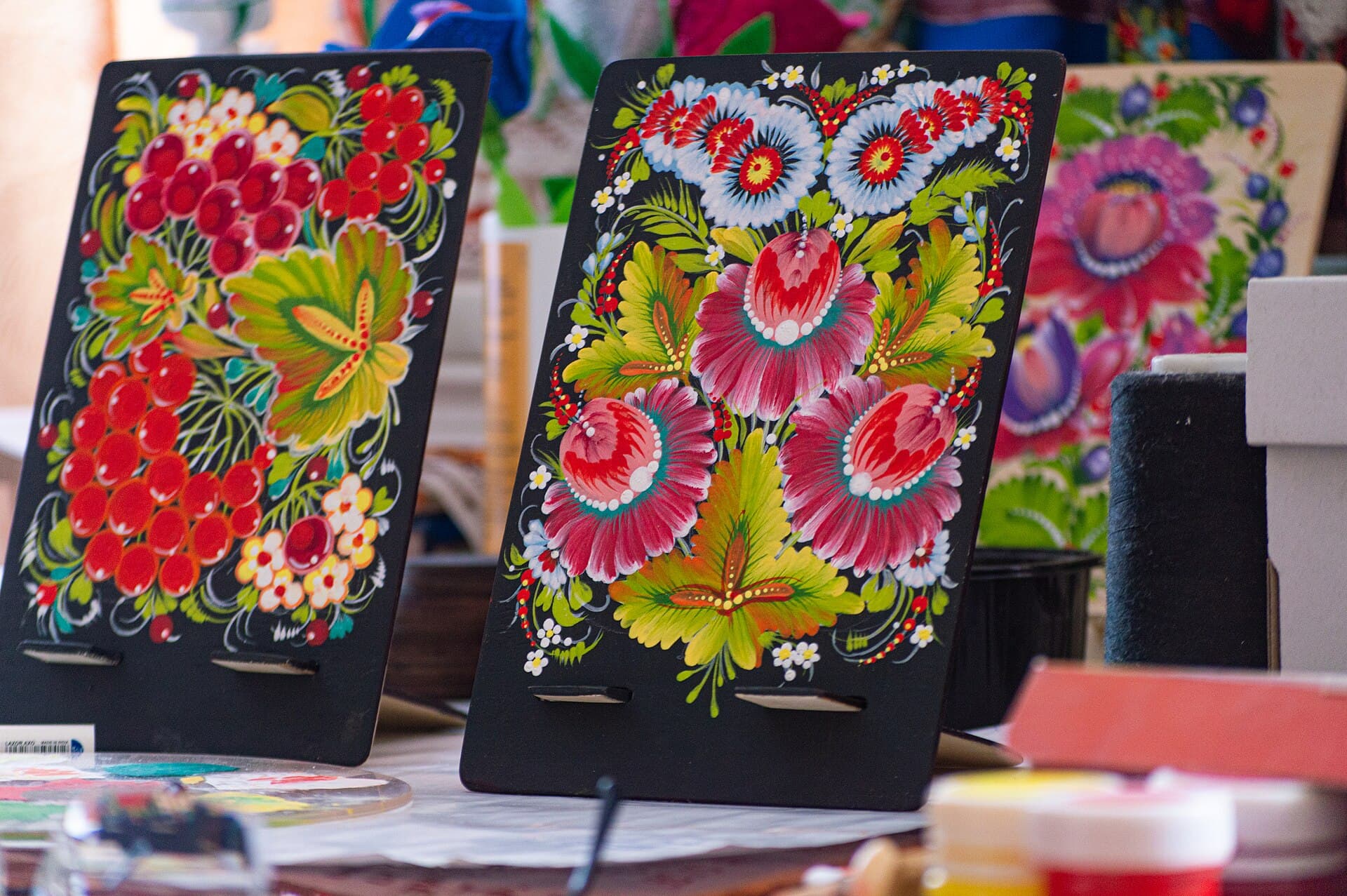
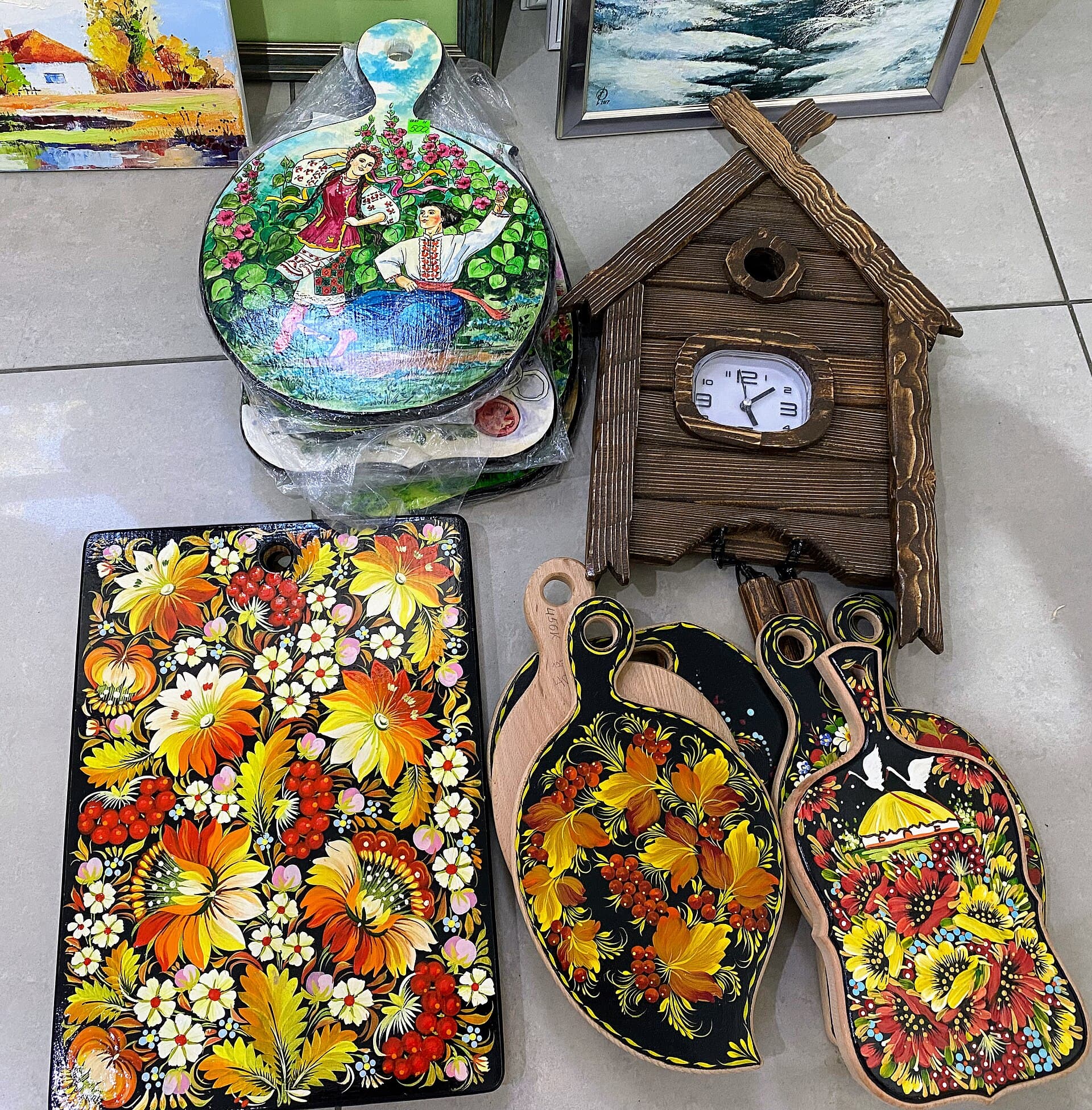
Boards, caskets, plates and baubles

The same vocabulary of strokes, carried onto whatever surface a household actually uses.

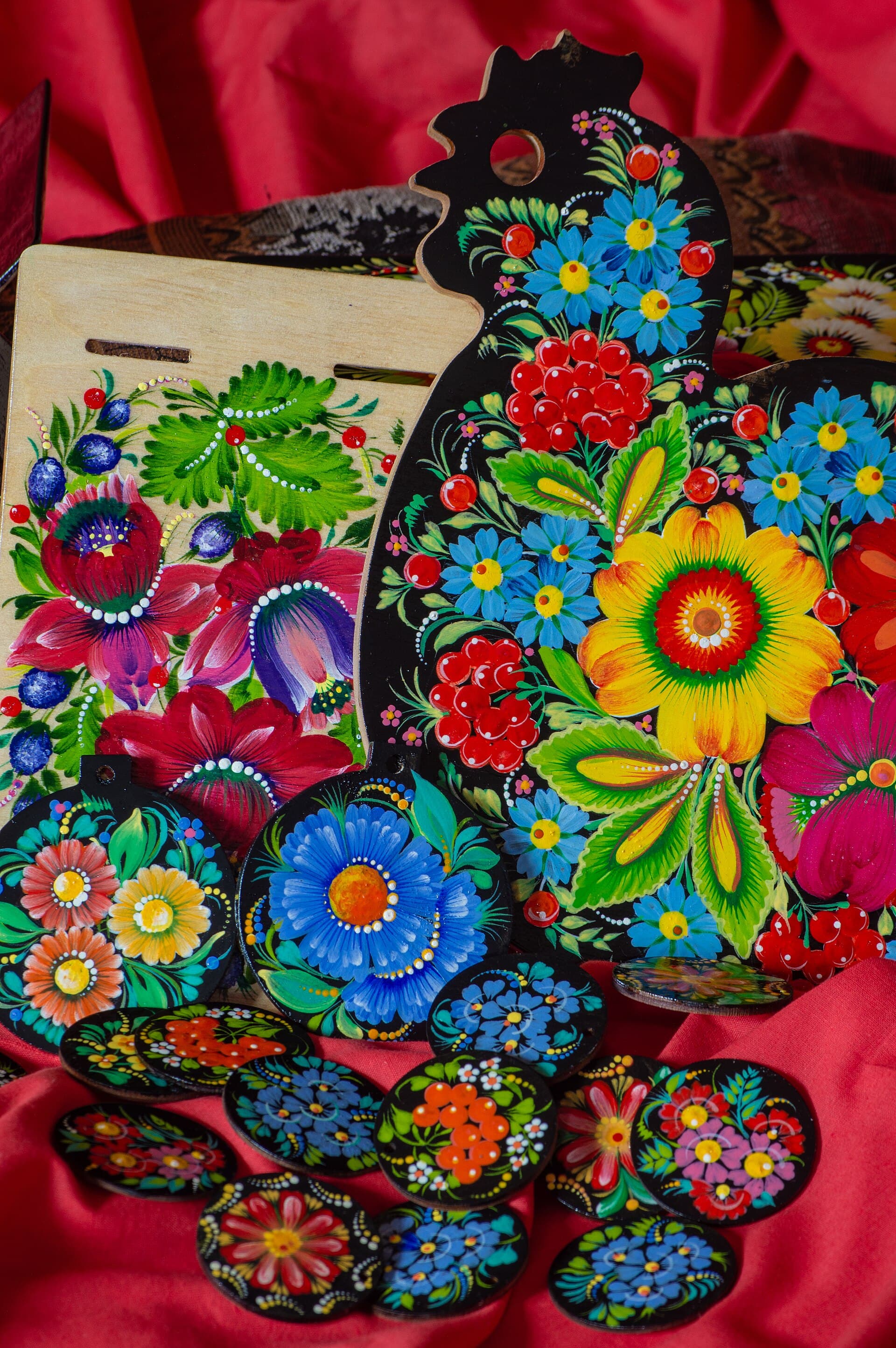
Medallions
Painted boards on a market stall
Kitchen boards, Poltava 2025
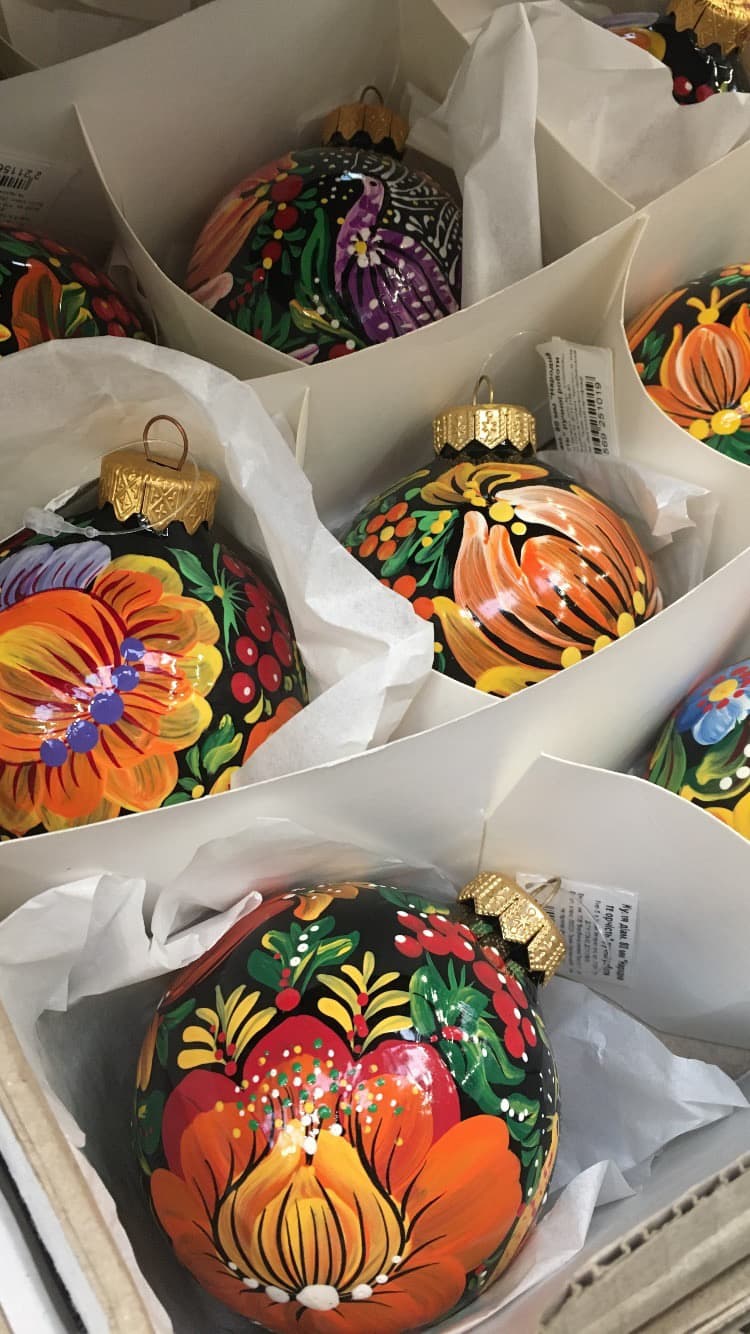
Painted Christmas baubles
A figured board and medallions
Porcelain vase
Chest, «Blue flowers»
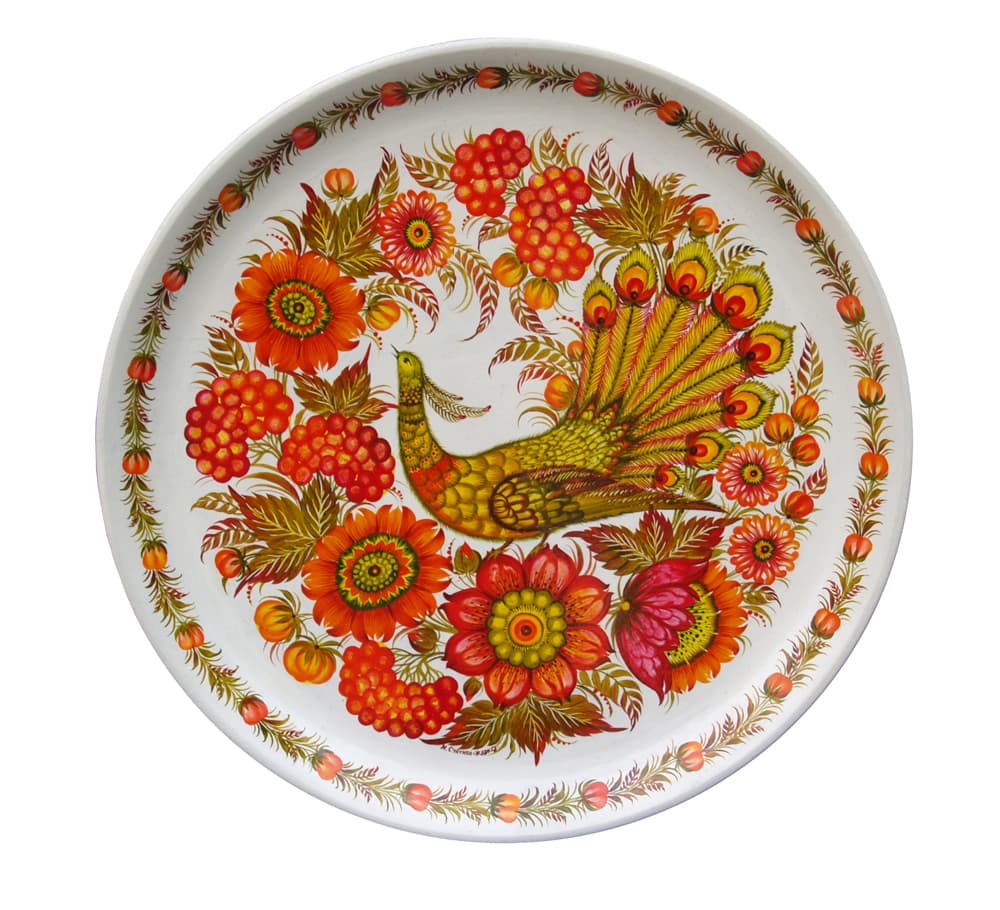
Plate, «August»
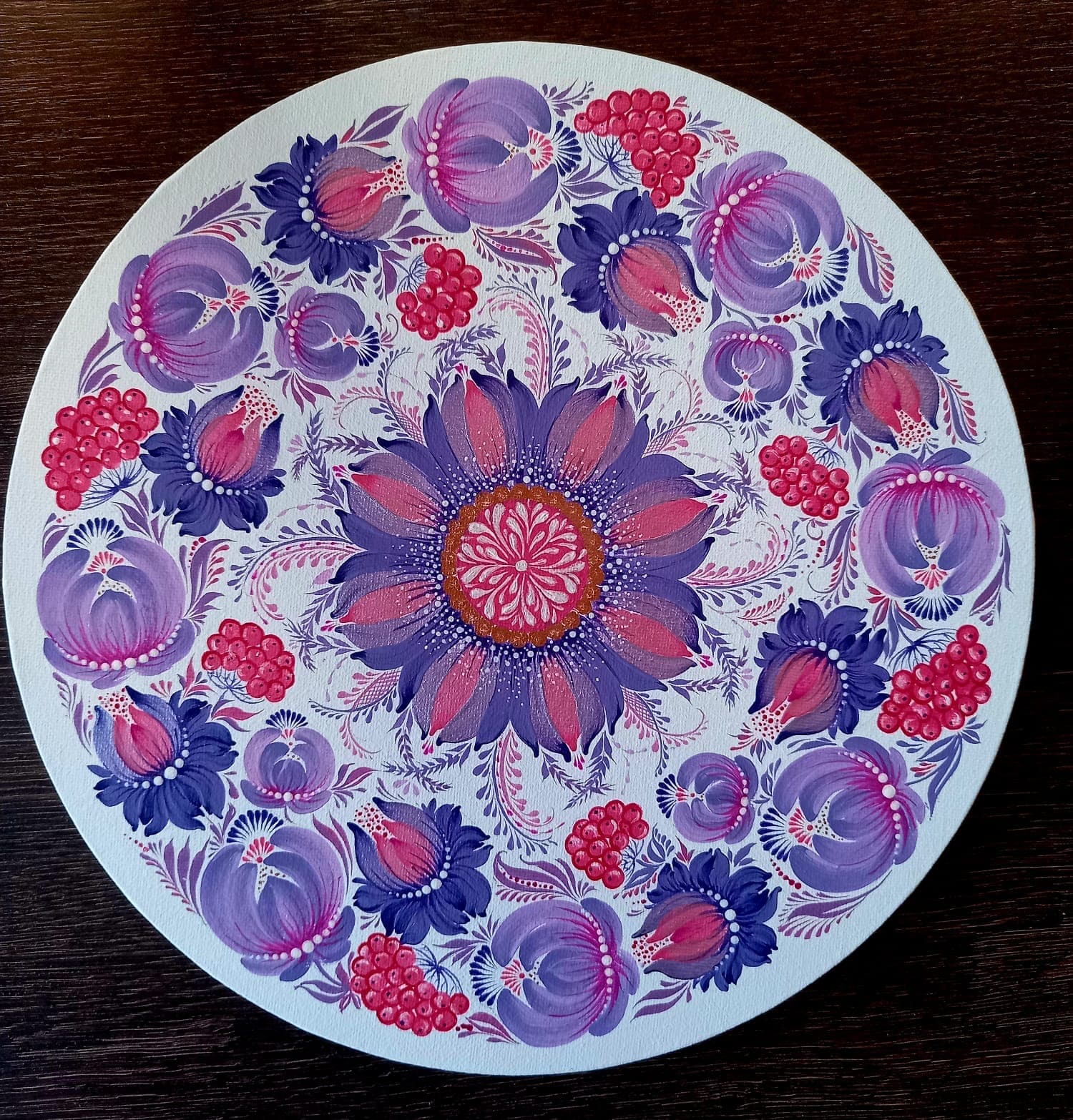
Painted plate, violet and crimson
Casket with viburnum, 1980s
Casket with a bird, 1980s
Casket on black, about 1985
Open the gallery →

Petrykivka · Oksana Pikush

Write to Oksana

What it's about