Petrikivka
UA

Learn · the first stroke is free

Twenty minutes, one brush, and the mark the whole tradition starts from

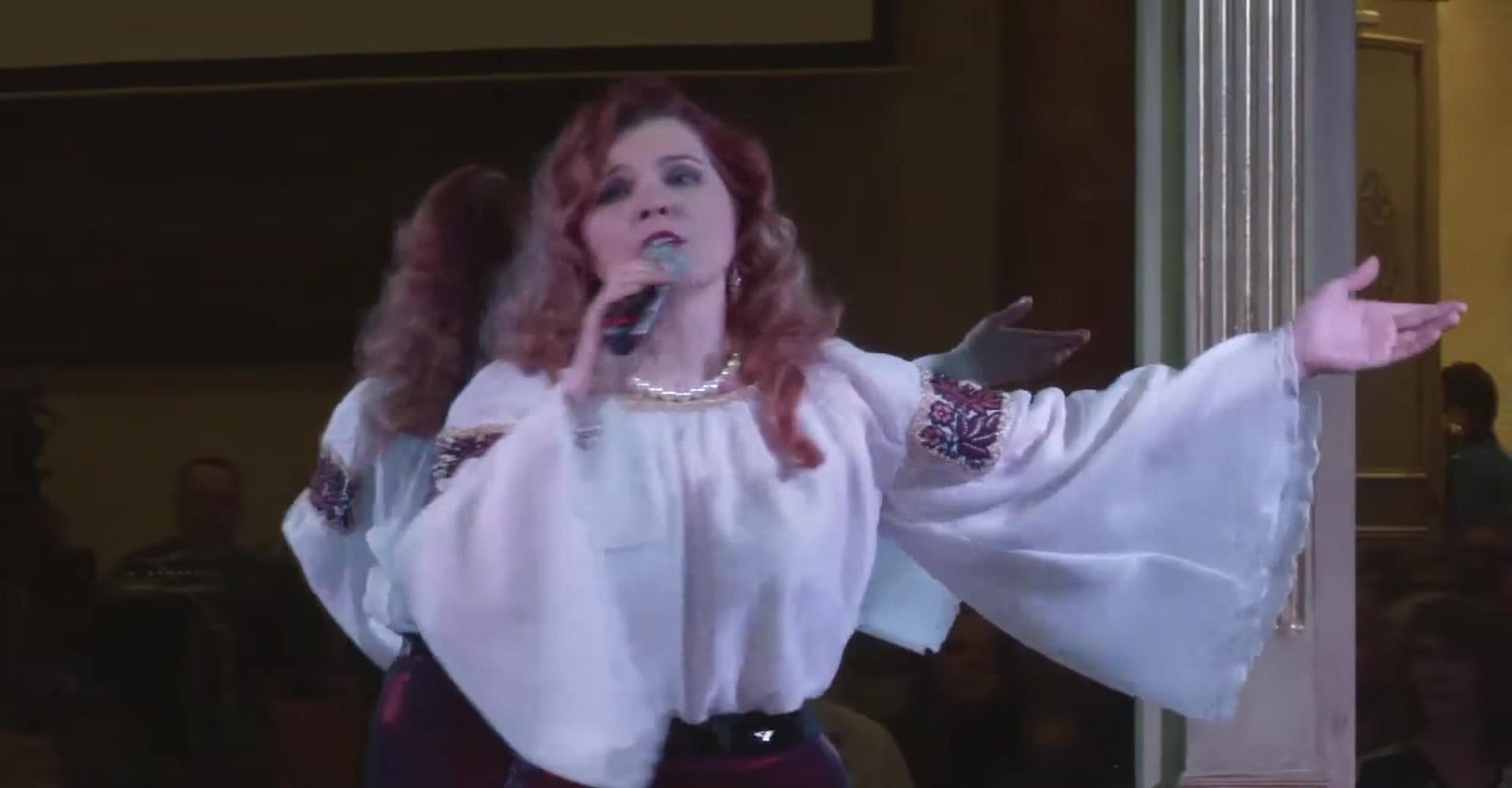
Oksana Pikush on stage in an embroidered blouse, arms open
Oksana Pikush · from her own channel

Zerniatko, the little grain, is the first thing a student in Petrykivka is given, and it asks for a brush, a saucer of paint and a sheet of paper. The lesson below is the real one, written from the teaching texts used in Ukraine. Work it at a kitchen table today; everything else in the vocabulary opens out of it.

Free lesson · zerniatko

The little grain

Zerniatko, the little grain. One pull of the brush that begins as a hairline and ends at full width — and a row of them set along a stem becomes an ear of grain, which is where the name comes from.

What you need

  • A brush — soft, round, coming to a fine point while it is wet. A plain watercolour brush makes this stroke; koshachka, the cat-fur brush, is for later.
  • Gouache or tempera — one colour is enough today. Soften the paint with a drop of water first, so it takes onto the brush readily.
  • Paper — white, uncoated, and more of it than you think. The painted sheet has its own name in the village: malovka.
  • A saucer and a jar of water — the saucer holds the paint at working thickness, the jar washes the brush.
  • Leave the pencil in the drawer. Masters lay the painting straight onto the surface with nothing drawn underneath, and drilling one mark is how a person gets to that.

The same teaching text that records masters working with no drawn outline allows a beginner a few light guide lines. Use them for the stem, and place the grains by eye.

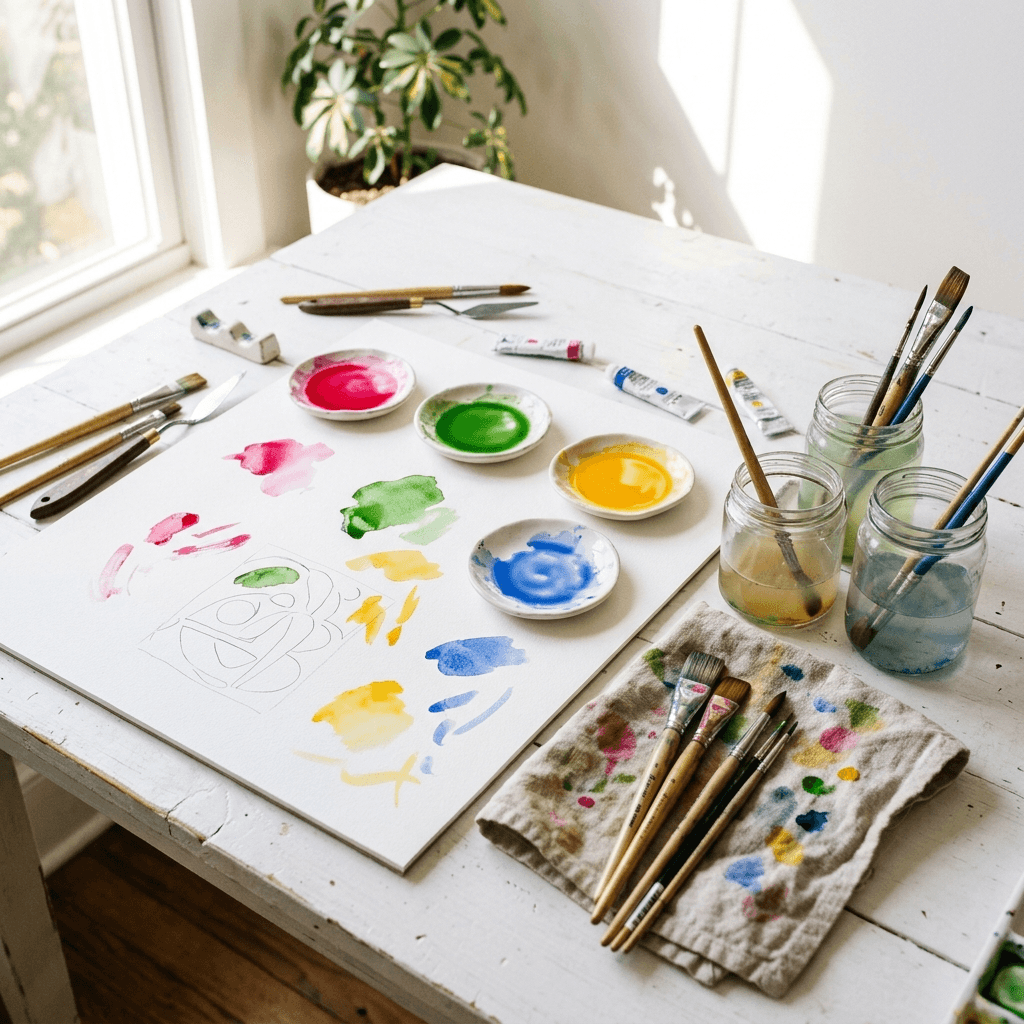
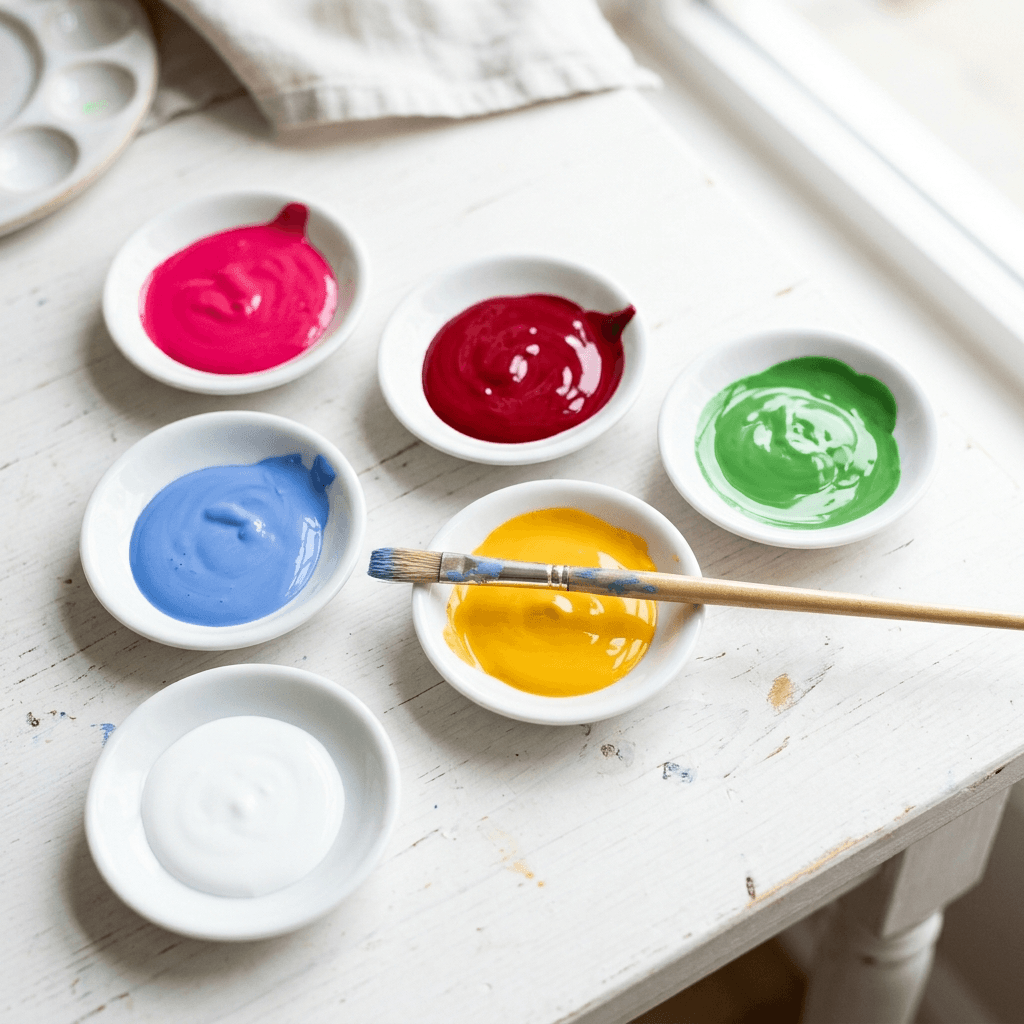
Saucers of thick wet gouache in pink, crimson, green, yellow and blue standing on a white table
One colour is enough today · interpretation, photographed for this site
A brush working a drop of water into stiff paint on a white saucer, the colour loosening at the rim
Softened to working thickness · interpretation, photographed for this site

The pressure curve

Load the brush and touch the tip to the paper so lightly that it leaves a hair. Then pull — and as you pull, let the brush down onto the sheet, so the mark widens under increasing pressure until the body of the hairs is lying flat. Lift straight off at the end. The whole thing lasts under a second.

Ukrainian teaching texts give it in one line, translated: «starting with a light touch, through to a strong press of the brush». Begin light, end pressing. Make twenty in a row without stopping to judge them. Then turn the sheet and make twenty more running the other way, so the hand learns the curve in both directions.

A brush mid-pull, laying one bright pink petal onto white paper with the tip still on the sheet
The curve, halfway through · interpretation, photographed for this site
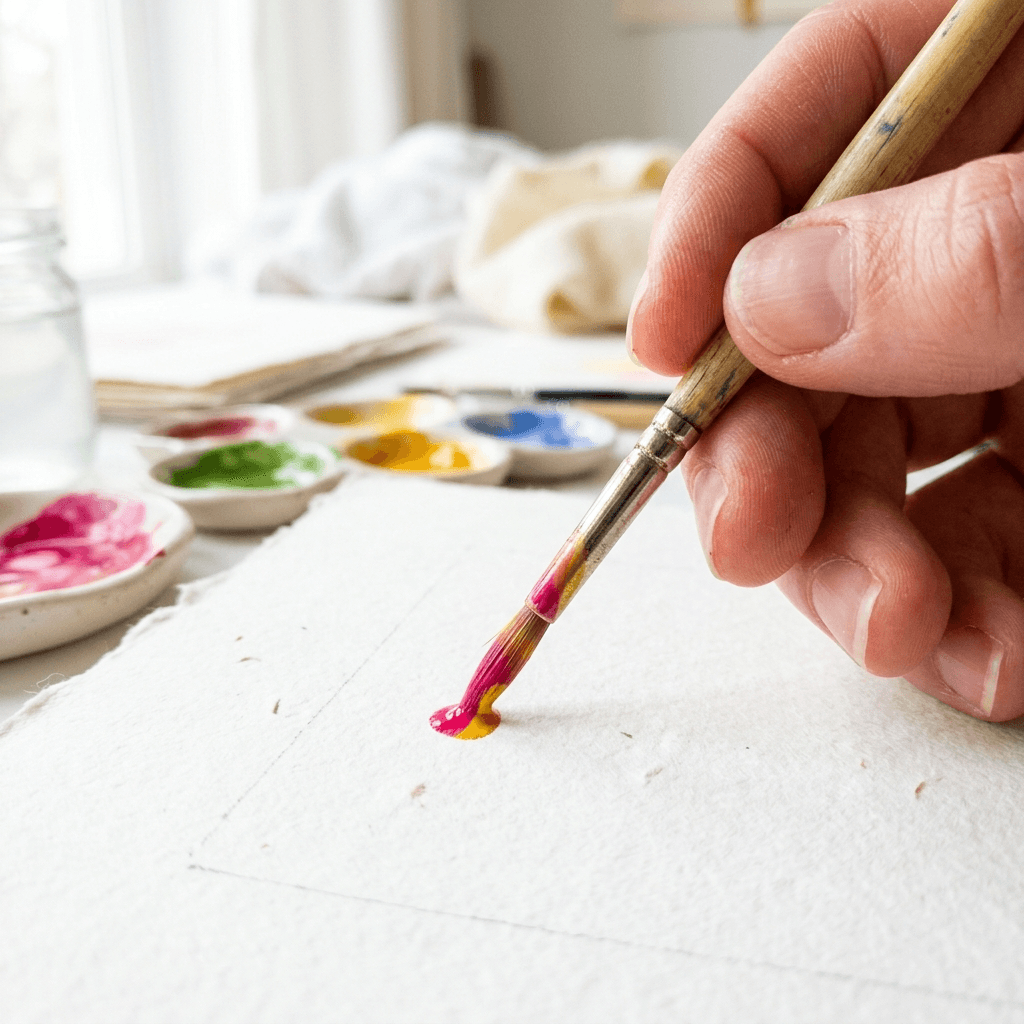
Fingers closed on a thin brush whose tip carries pink and yellow at once, held above a white sheet
The grip the mark is made with · interpretation, photographed for this site

What a good one looks like

A usable zerniatko has a tip you have to hunt for: the paper takes the hair and the mark only becomes visible a millimetre in. It swells evenly, with no step where the pressure jumped. It finishes full, the widest point at the very end rather than somewhere in the middle.

Hold the sheet at arm’s length. A row of good ones reads as grain on a stalk. A row of failed ones reads as scattered commas.

Diagnostics

Three things that go wrong

01

The curve runs backwards

Pressing first and dragging away makes a real stroke, and it is a different one: that is hrebinets, the comb. Both live in the vocabulary, so the error stays invisible until you rank your grains along a stem and the ear of grain points the wrong way.

Check the first millimetre of the mark. Zerniatko begins as a hair.

02

Going back to repair it

Petrykivka is laid straight onto the surface with nothing sketched underneath, which means a mark is placed once. A second pass over paint that has started to set flattens the taper and leaves a seam across the middle.

Let a poor grain stand, and put the next one down beside it.

03

Every grain identical

The tradition’s own defence against a mechanical look is the changing angle: in abihunets, the running border, the flowers sit at equal intervals and the tilt shifts every time. Grains ranked at one unvarying angle read as printing, and that is the easiest way to tell a painted band from a repeated vector one.

What to do next

Fill one sheet with zerniatko. Then run the same curve backwards — press first, drag away into a whisker — and that is hrebinets. Then lay the grain on an arc for kryvenke zerniatko, the crooked grain. Three marks, and three of the four that carry the whole tradition are in your hand.

The fourth is perekhidnyi mazok, the transitional stroke: one dry brush carrying two paints, colour in the body and colour on the tip, laying a gradient inside a single mark. It is the move the school is known by, and it is the one worth learning from a person in the room with you.

A kitchen table in daylight with white paper, a saucer of paint, a jar of water and three brushes laid out ready
Everything the first twenty minutes ask for · interpretation, photographed for this site

What a finished sheet looks like

Four sheets to hold your own against

The marks in the lesson above build all four of these. Each one is a real work photographed by someone who went to see it, and the credit its licence asks for travels with the picture.

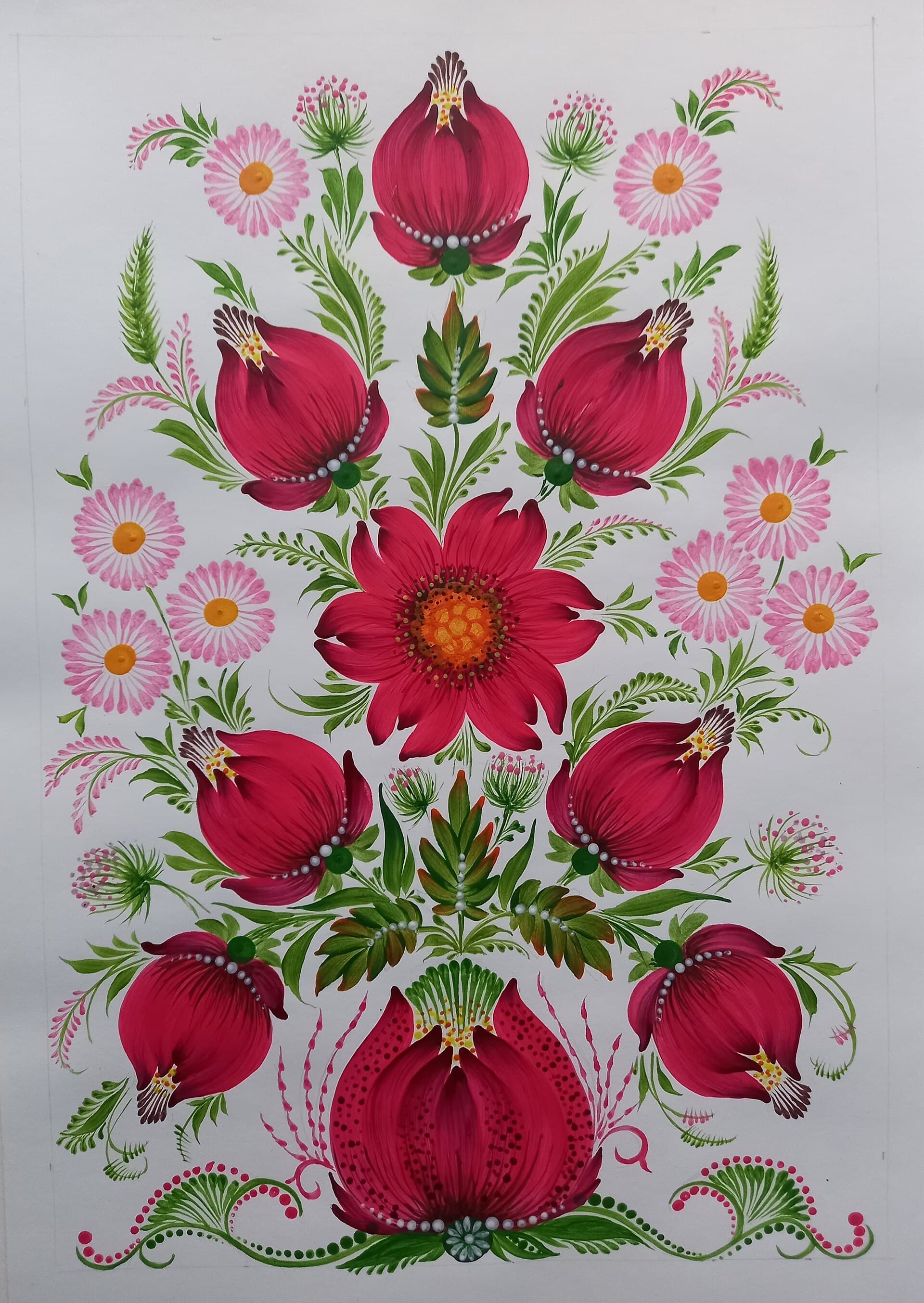
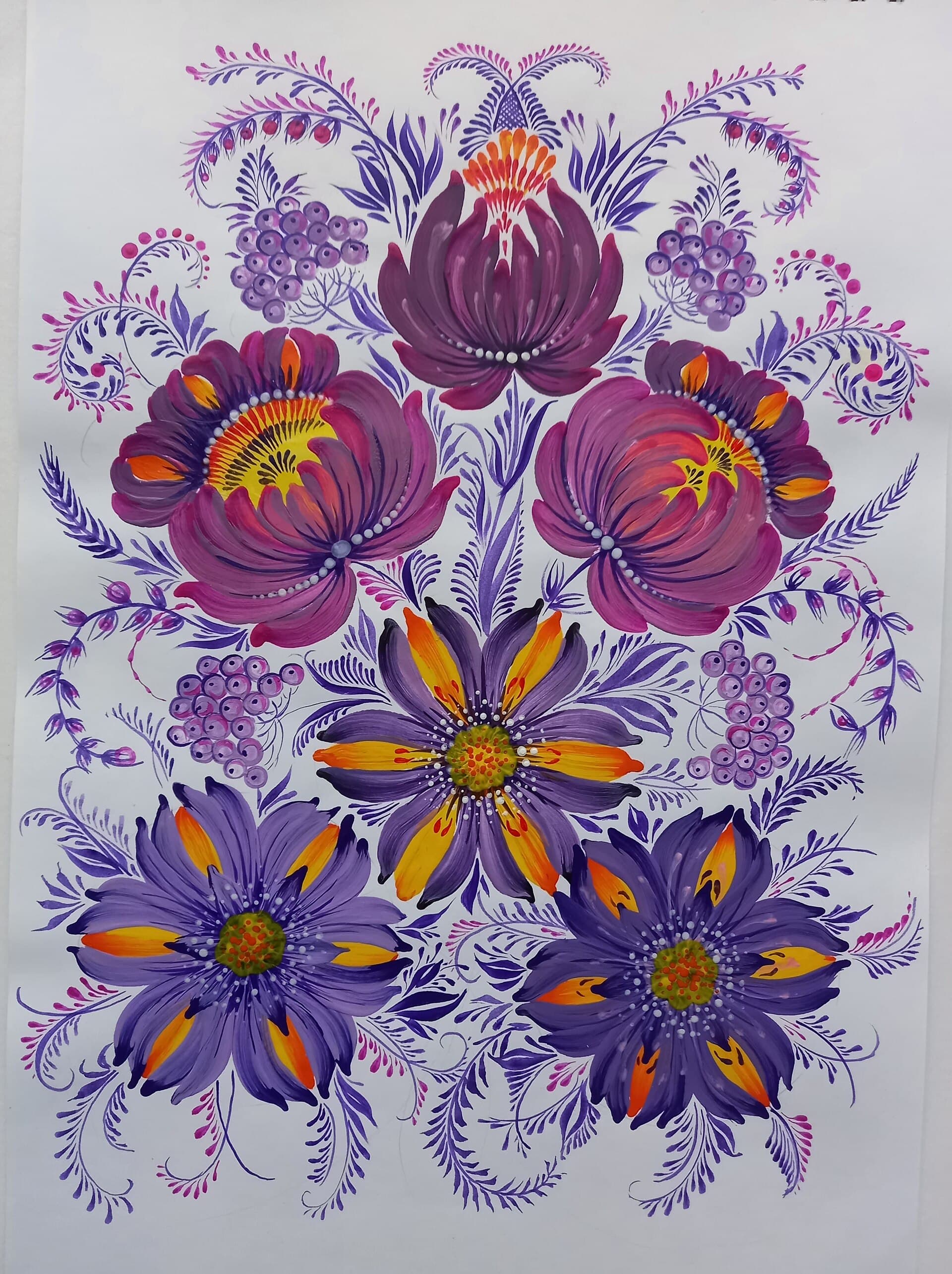
Rose vazon on white

Rose vazon on white

The vertical vazon in its plainest form, on the historic white ground.

Sunshine ND · CC BY-SA 4.0 · painter unrecorded

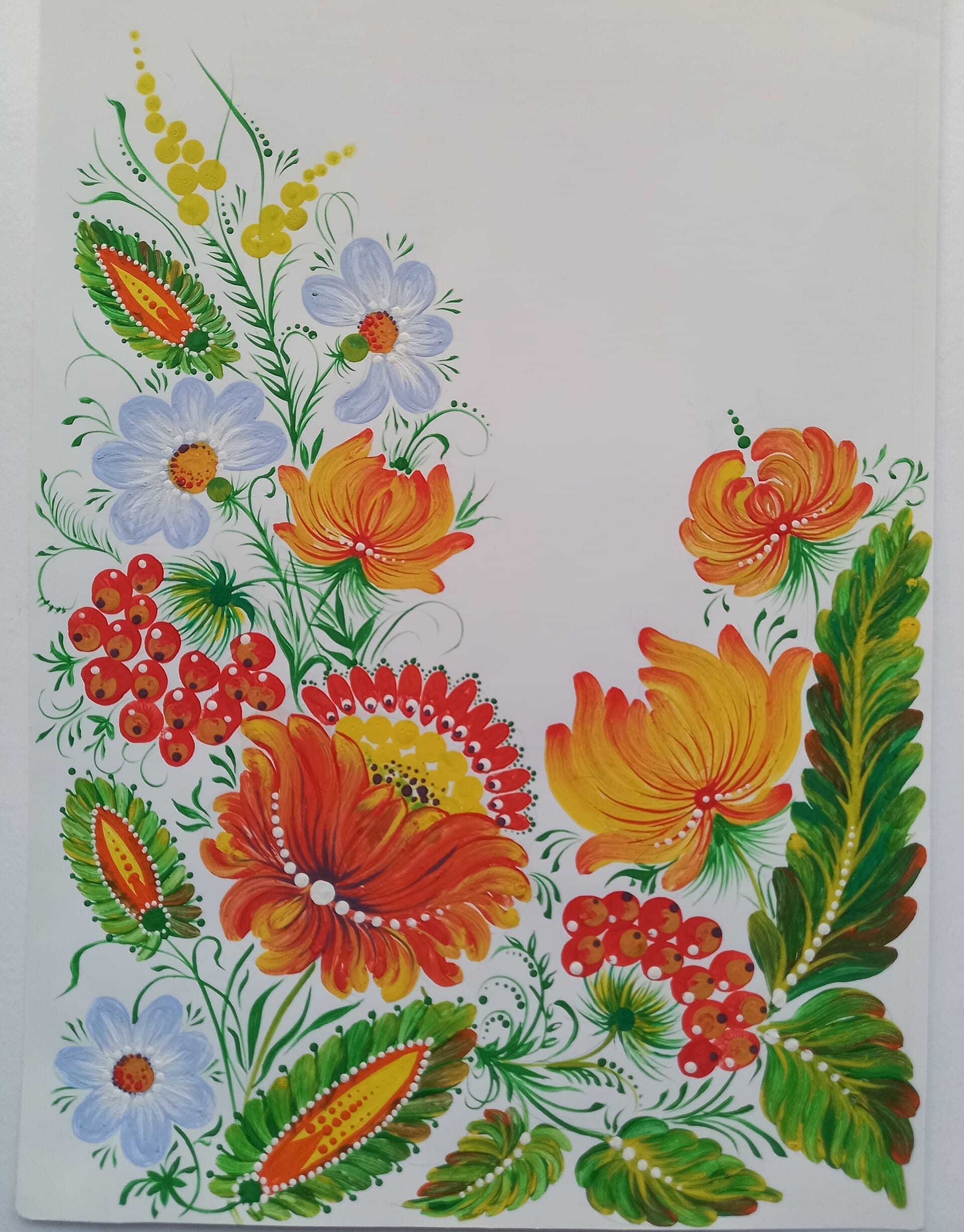
Corner spray with grasses

Corner spray with grasses

A corner composition, the form a painter uses on a chest lid or a door panel.

Sunshine ND · CC BY-SA 4.0 · painter unrecorded

Carpet of poppies and asters

Carpet of poppies and asters

The kylymok — a field composition that fills its rectangle evenly from edge to edge.

Sunshine ND · CC BY-SA 4.0 · painter unrecorded

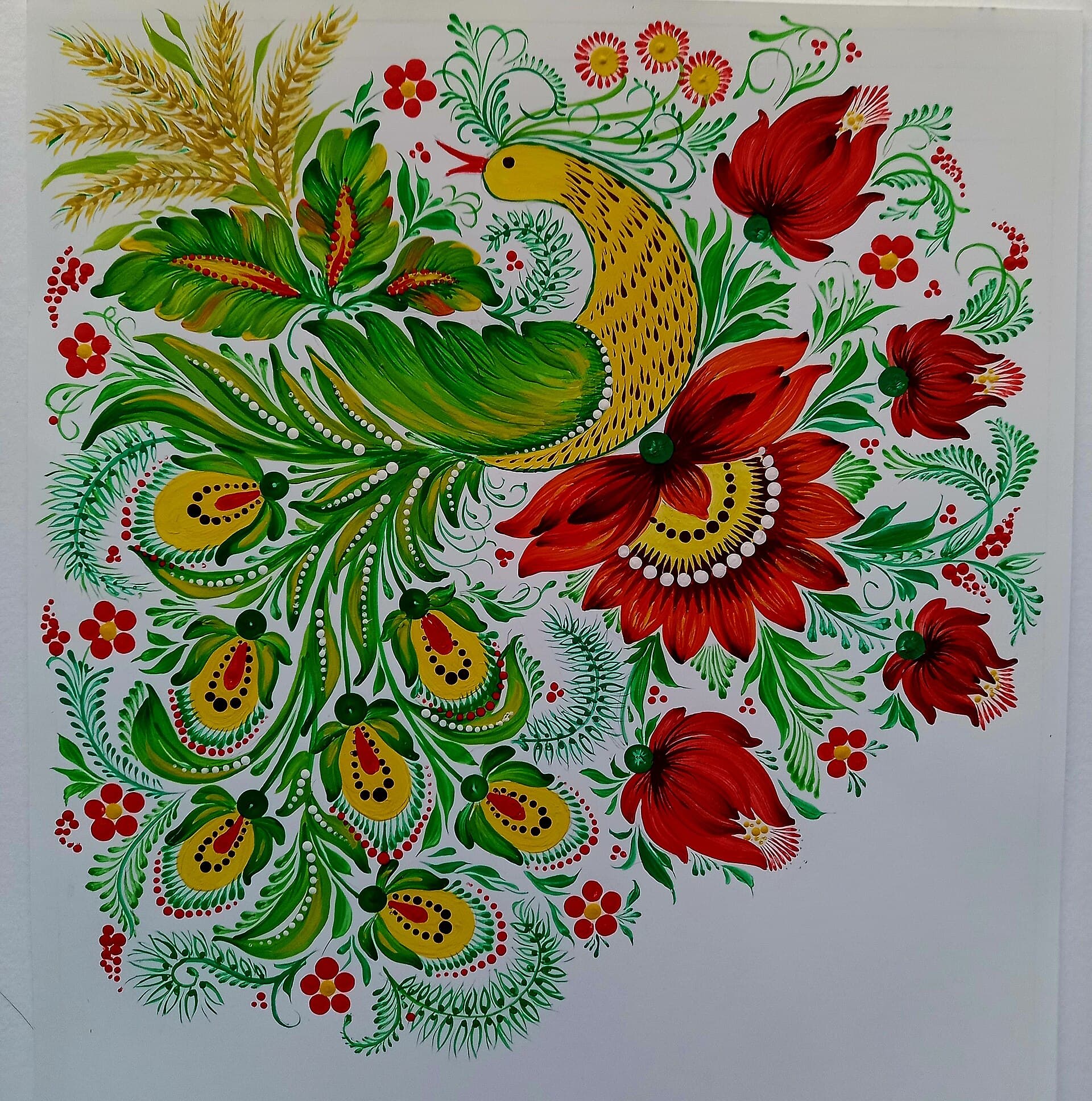
Bird in a green wave

Bird in a green wave

A bird set into a single sweep of leaves, with grains ranked along every stem.

Sunshine ND · CC BY-SA 4.0 · painter unrecorded

Tools

Three instruments, and honest substitutes for all of them

Two of these a painter makes by hand, and the third is the hand itself. Industry never took up the koshachka, so every master still builds her own.

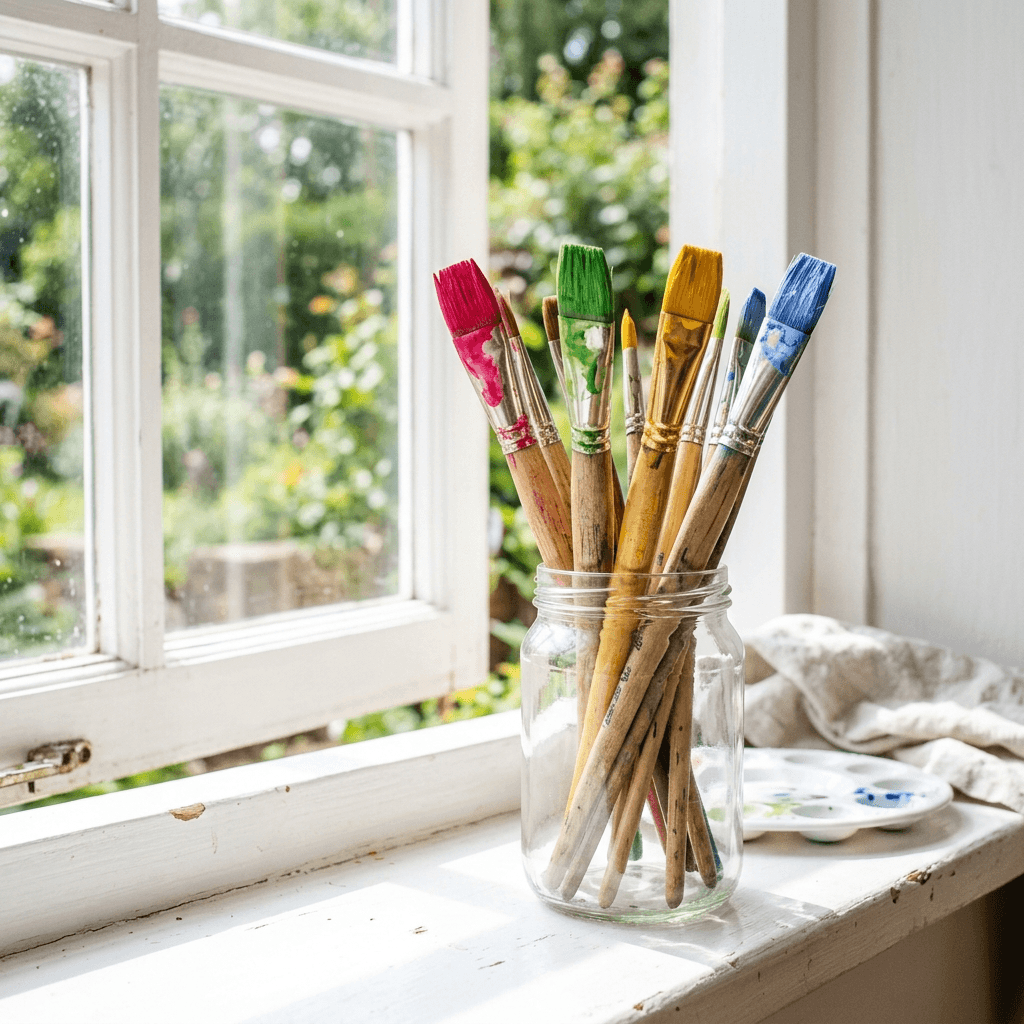
Handmade brushes standing in a glass jar, their tips still loaded with pink, yellow and green
Tips still carrying the last colour they worked · interpretation, photographed for this site
Soft animal hair being bound with thread onto a straight peeled twig to make a brush
Hair bound to a twig, the way a master makes one · interpretation, photographed for this site
01

koshachka

the cat-fur brush · also kotiachka in Petrykivka itself

Soft cat fur bound with ordinary thread onto a straight twig, made by the painter herself. Masters have worked through the alternatives — wolf, hare, squirrel bristle — and settled on the cat. Halyna Nazarenko’s verdict to Ukraïner, translated: «none of it is right. But a kitty, that is just what is needed». The fur is exceptionally elastic, and one brush draws both an ordinary line and the finest tracery.

It is combed out with a fine comb, which is where the question every Western reader asks gets its answer. Nataliia Rybak describes the work as serious diplomatic negotiations with the cat, conducted so that she agrees and refrains from scratching. The older the brush, the more worked-in it is, and the more it is prized.

Ukraïner, from the masters in Petrykivka ↗
02

rohozynka

a sharpened stem, cut at the water

A stick cut from a tree shoot or from a marsh stem — rohiz, the bulrush, and osytniah, the rush — sharpened to draw hairline work. The Chaplynka river at Petrykivka still runs thick with bulrush; the reed-weaving craft that used it has no masters left.

Wikipedia UA, on the toolkit ↗
03

The finger

berries, in clusters

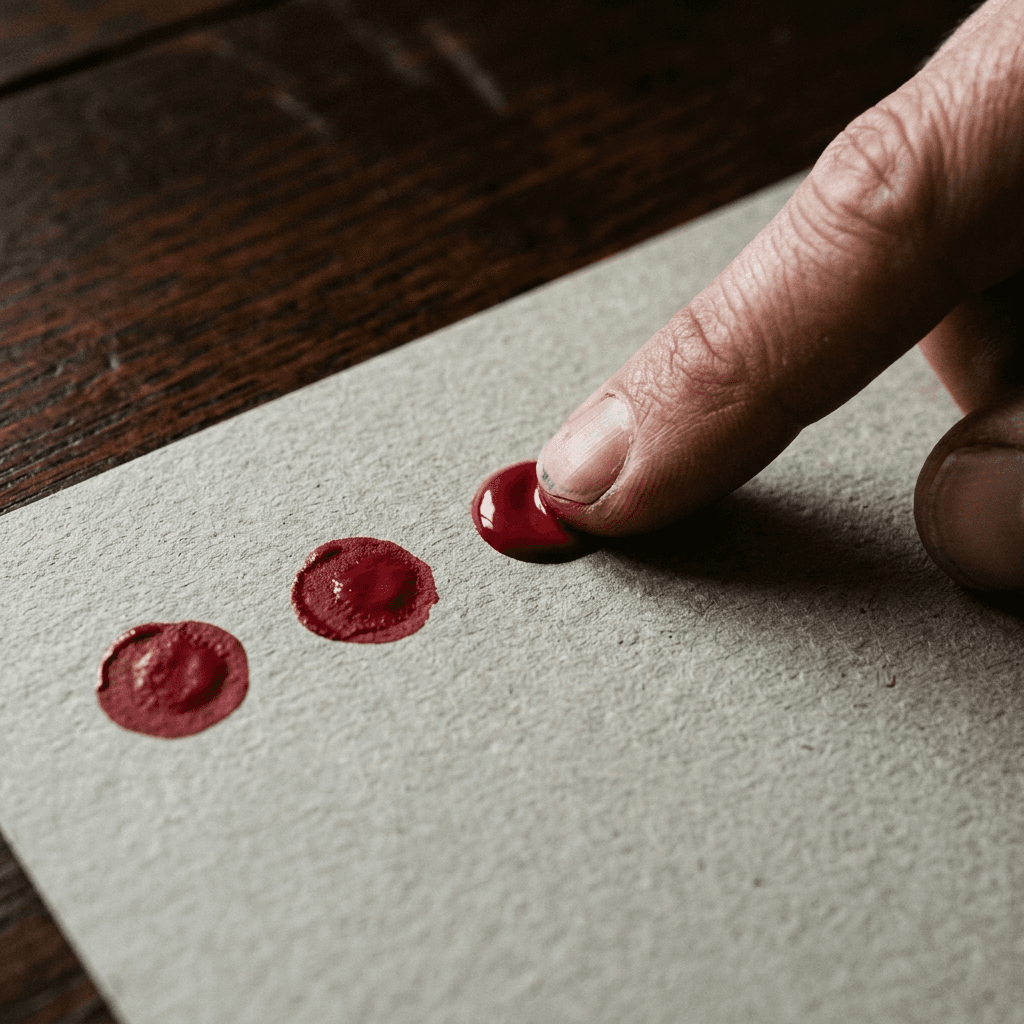
Berries are set with a fingertip, and the mark has a signature anyone can read: a round dot, lighter and raised at the centre, ringed by a darker edge where the pigment was pushed outward. Fingerprints are part of the finished work.

The tradition already carries its own substitutes for the hand — a kvachyk, cotton wound onto the end of a stick, and a dropper.

The Great Ukrainian Encyclopedia, on the finger and the kvachyk ↗
04

What to use instead

for anyone starting with none of the above

Squirrel-hair and synthetic brushes belong to the normal modern kit, and the state encyclopedia lists factory brushes among the tools. The teaching texts say plainly that an ordinary watercolour brush with a thin sharp tip serves for zerniatko,kryvenke zerniatko and fine branches — which covers everything in the lesson above.

One job resists substitution. The koshachka has no commercial equivalent for petushynnia, the fine tracery that gives a composition its transparency, and nobody manufactures cat-fur brushes at all. Masters can tell by eye which brush painted a sheet, and the encyclopedia captions its own gallery accordingly.

Oksana Pikush makes her own brushes and carries them over from Petrykivka, and everybody in one of her classes is handed one. A set of three to take home and keep painting with is CAD $60, and it comes with the class or on its own.

A cut marsh reed stem sharpened to a point, lying on unbleached paper beside the single hairline stroke it has just drawn
A reed cut for the finest lines · interpretation, photographed for this site

The order it is taught in

What a beginner does, in sequence

Two teaching sources in Ukraine — the Dnipropetrovsk regional library’s «Fundamentals of Petrykivka Painting» (Osnovy petrykivskoho rozpysu) and the lesson plans used in schools — agree on the shape of this and differ on the wording. Read it as how Petrykivka is generally taught, rather than as one official curriculum.

  1. 01zerniatko (the little grain) on a palette, until the pressure curve is automatic
  2. 02hrebinets (the comb), the same stroke run backwards
  3. 03kryvenke zerniatko, the grain laid on an arc
  4. 04horishok (the hazelnut), the first compound element
  5. 05perekhidnyi mazok, one brush carrying two paints
  6. 06travychka (the grass), kolosok (the ear of grain), pupianok (the bud), yahoda (the berry)
  7. 07lystok (the leaf), tsybulka (the little onion), kucheriavka (the curly one) and the named garden flowers
  8. 08bihunets (the runner), the first whole composition

Whole compositions come after the list — hilochka, the sprig; buket, the bouquet; vazon, the flowerpot; kylymok, the little carpet. By then the marks are happening without being thought about, which is the reason the first weeks are spent on a palette.

The room, the paper and the garden those compositions come out of

A studio windowsill with jars of water, brushes and a painted sheet propped against the glass
A stack of white uncoated sheets on a table, the top one still blank
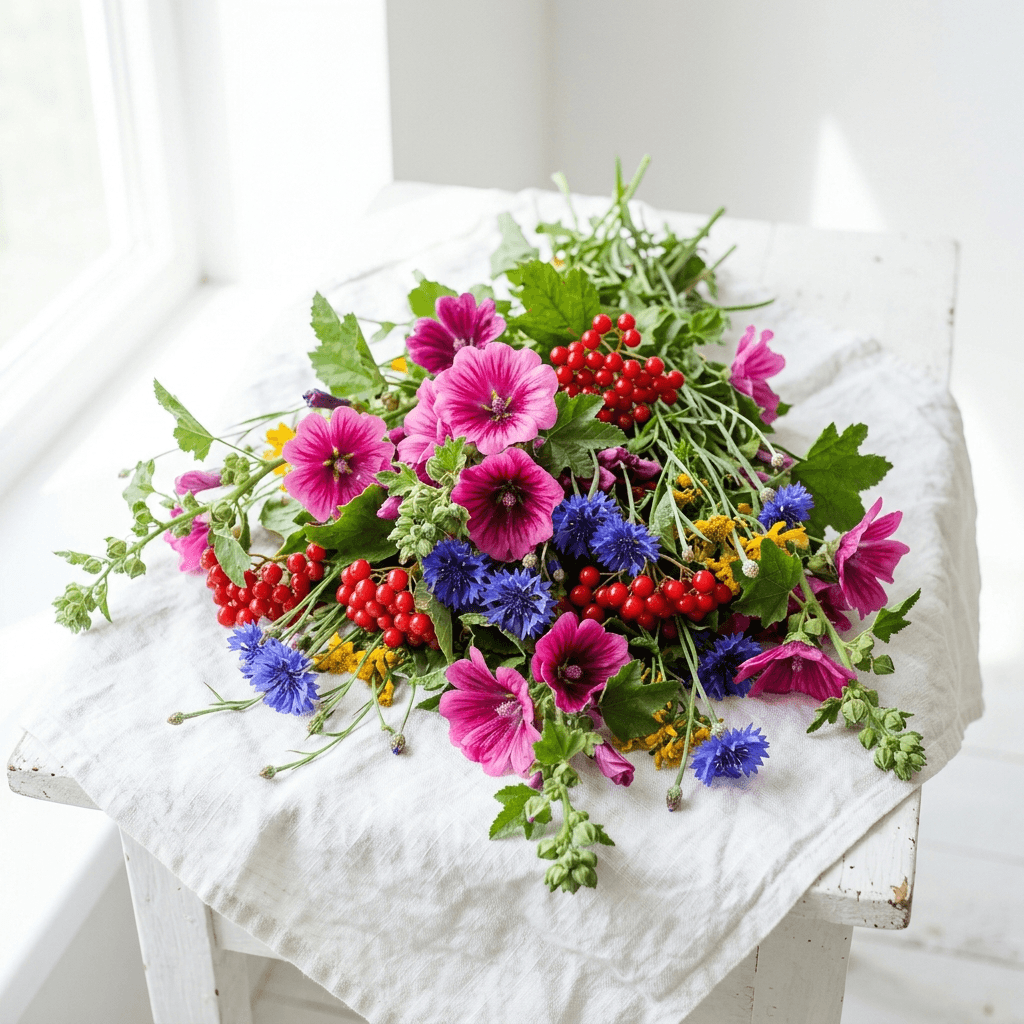
Pink mallow and a heavy cluster of red viburnum berries lying together on a table
Sunflowers standing head-high against open steppe under a wide bright sky
An embroidered cloth in red and black stitching, folded back on a table
A fingertip pressing a round berry of red paint onto paper beside a cluster already set

Six interpretation photographs made for this site. The paintings themselves live in the gallery, each one with its credit and licence.

Classes

Learning it from the family it ran through

Oksana Pikush was born and raised in Petrykivka and learned the craft at home — from her parents, Andrii and Maria Pikush, and from the master Ivan Dmytriuk. She teaches children and adults across the Greater Toronto Area, where she has run a six-week course at the St. Vladimir Institute and classes in schools, parishes and community halls, and she paints interiors and murals.

A child's hands holding a brush over a sheet already covered in bright grains and finger-set berries
A child’s sheet part way through a class · interpretation, photographed for this site
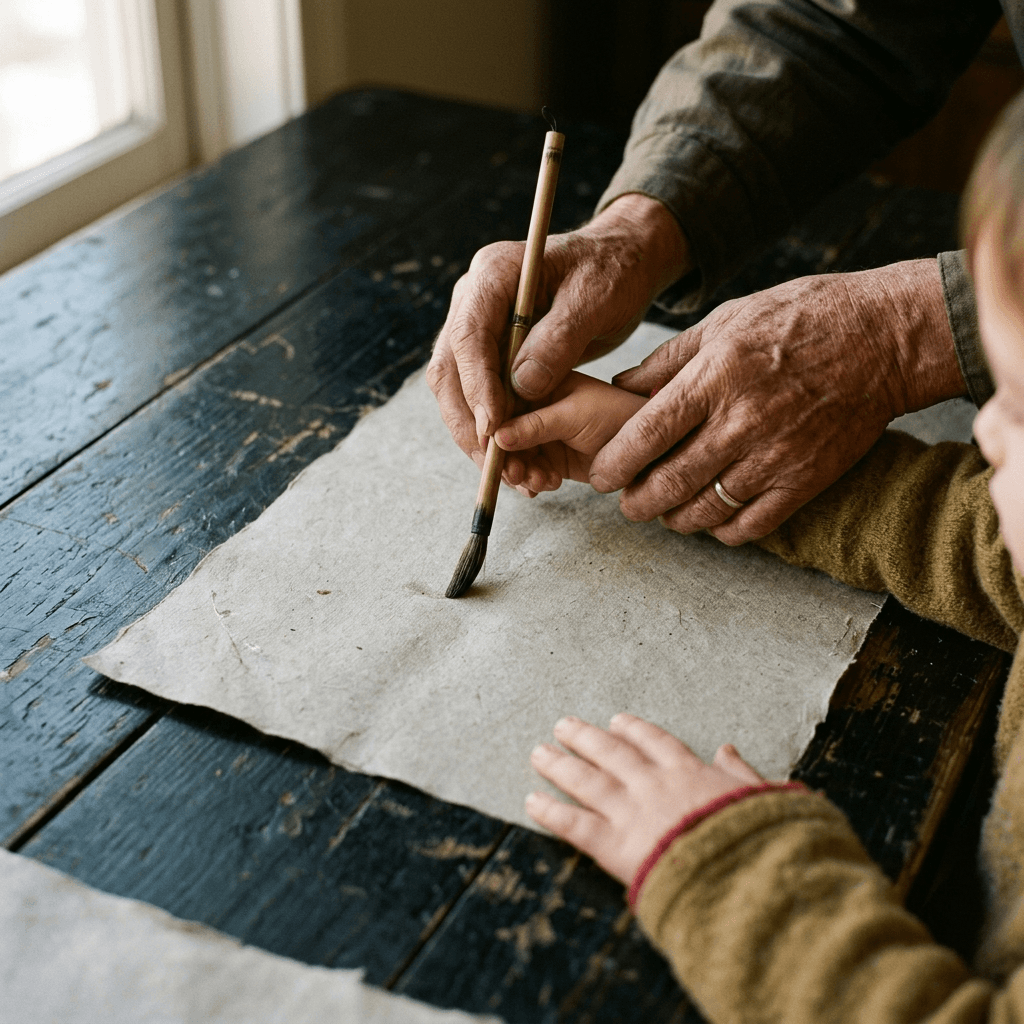
An older hand steadying a younger hand on the brush while the stroke is pulled across the paper
The handover this craft has always run on · interpretation, photographed for this site
01

Children

In person · ages 7 and up · CAD $35 a child

Oksana teaches children as part of her regular practice, and every child in the room is handed a brush she made herself and carried over from Petrykivka. The order is the one listed above: the grain first, on a palette, until the pressure curve stops asking for attention.

A children’s class runs 90 minutes and takes 5 to 20 children, from age 7. Dates are set term by term with schools, parishes and community halls across the Greater Toronto Area, and the next ones come back in the reply to your email.

02

Adults

In person · 2.5 hours · CAD $55 a person

Adults begin where a child begins, with the same stroke on the same palette. Across the diaspora an adult Petrykivka class has settled at two to three hours: the Ukrainian Museum of Canada charges CAD $35 for a two-hour workshop with materials included, and the Taras Shevchenko Museum in Toronto CAD $50 plus $10 for materials.

Oksana’s class runs 2.5 hours at CAD $55 a person, with gouache, paper and a brush of her own making in the price. The brush goes home with the student; the full set of three she brings from Petrykivka is CAD $60. Her rate sits at the top of the diaspora band because the brush in the student’s hand was made by a master in the village the painting is named after.

Comparable workshop pricing, Ukrainian Museum of Canada ↗
03

A booked group

In person · 5 to 20 people · CAD $50 a person

A school, a parish hall, an office team or a birthday can book the room itself and fill it with its own people. The session runs 2 hours, Oksana brings the paint, the paper and a brush for every pair of hands, and everybody leaves carrying a painted sheet.

The rate is CAD $50 a person for 5 to 20 people, and travel inside 150 km of the Greater Toronto Area is already in it. Further out, the journey is quoted with the date.

04

Online

Remote · 6 live sessions · CAD $220

For people with no Petrykivka teacher within driving range. One caution belongs on this page in a master’s own words: Valentyna Panko says a video can show the technique, and the technique is only part of what is being handed over. So the honest version of a remote class states what it carries and what waits for a room, before anyone pays for it.

The course runs live on Zoom — 6 sessions, one a week, with places held to 20 so Oksana watches every hand on screen. It carries zerniatko, hrebinets and kryvenke zerniatko as far as a camera can carry them. Perekhidnyi mazok, the two-paint stroke, is the part that waits for a room, and the course says so before anyone pays. CAD $220 for the 6, paid once.

Valentyna Panko on teaching by video ↗
05

One-to-one mentorship

Remote or in person · 4 sessions · CAD $450

For a painter who already has the strokes and wants a master over their shoulder. The mentorship is 4 sessions on the student’s own work, at dates the two of them set; between sessions the student sends photographs of what they have painted and gets written notes back on each sheet.

CAD $450 covers all 4, and most people take one a fortnight.

06

Murals and interiors

A separate track · CAD $650 a day · booked 8 to 12 weeks ahead

Oksana’s own specialisation is interior decoration and wall painting, and it runs apart from the teaching: a brief, a surface, a schedule and a price agreed in writing before a brush is picked up. Walls are where this art began: it went onto limewash inside the house and out, and was renewed several times a year before the great feasts.

Painting on site is CAD $650 a day, a whole room starts at CAD $4,500, and the calendar for a room fills 8 to 12 weeks ahead. The commission page carries the rest of the terms.

Start a brief →

Booking runs through this address. Put three things in the email: which class from the list above, how many people are coming, and which city you are in. Oksana answers within 3 days with the next dates, the room or the Zoom link, and how to pay.

Next

The rest of the vocabulary

Four strokes carry the tradition, and every element is assembled out of them. The glossary gives each one its Ukrainian name, its English gloss and the movement of the hand that makes it — with an honest note about where the names came from, and about the one name we left out.

Petrykivka · Oksana Pikush

Write to Oksana

What it's about